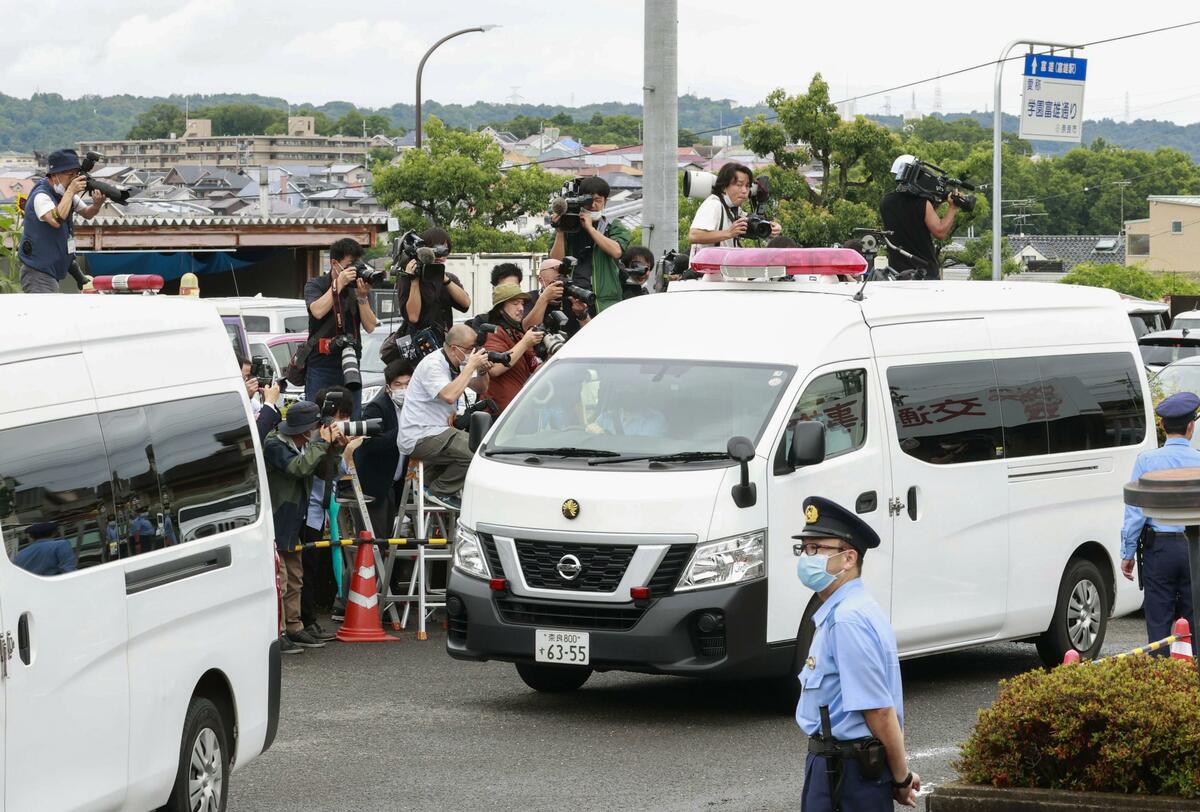
News Former PM Abe assassinated during campaign speech in Nara

I don't see what removing that will do for anyone honestly. There is not a road on the other side, so the only options are a right or left turn anyway. Unless they are also changing the other side. That crosswalk is a bit scary though, people whip into and out of it and I always have crossed further down the road where there is more visibility to drivers and people in the crosswalk.
It says that whole area will be roadway by next year.
 
It says that whole area will be roadway by next year.
I saw that, but it doesn't really make any sense, not unless the other side of that cross road turns into a road or something. Its a small parking lot or taxi/bus stand right now.

2022-12-19 20_48_25-Nara Family kintetsu.webp
 
Looks like a good spot to put in a dedicated taxi or bus lane so buses can go straight across. I guess it will be a mystery until next year (or until somebody cares enough to Google the plan).
 
The Nara District Prosecutor's Office has decided to indict Yamagami Tetsuya, 42, for fatally shooting former PM Abe following a psychiatric evaluation. The period of his detention will expire on 10 January.

Yamagami has told investigators that he held a grudge against the Unification Church, a religious group known for its mass weddings and aggressive donation solicitations, and targeted Abe over his links to the group, investigative sources have said.

 
Today, Yamagami Tetsuya was transferred back to Nara following the end of his psychiatric evaluation at the Osaka Detention House. A formal murder charge is expected to be filed by 13 January, when the detention period for Yamagami ends.


Asahi Shinbun reported that the police learned of Yamagami's grudges against the Unification Church on the day of Abe's shooting but did not disclose that fact during a news conference held on the same evening, referring simply to a "certain group." In criminal cases, suspects are allowed to make a statement soon after police explain why they are arrested. Yamagami admitted to the shooting during police questioning at the Nara-Nishi Police Station, to which he was taken immediately after his arrest.


Police were perplexed as to how to explain the motive to the media considering the fact it concerned a religious group, a delicate issue. Prior to the scheduled news conference, police officials huddled to discuss strategy to explain the chain of events. Given the gravity of the case, police agreed it would be impossible for them not to refer to Yamagami's motive. But they also decided it would be inappropriate to refer to the Unification Church at such an early stage in the investigation, given that its relations with Yamagami and Abe were not yet fully understood. Police officials were also concerned that if they simply cited a "grudge against a religious group," many people might presume it meant Soka Gakkai, a community-based Buddhist organization and key support base of Komeito, the junior partner of the ruling coalition. That, they feared, could affect the fairness and neutrality of the Upper House election that would be held two days later.

 
While in detention, Mr Yamagami received a steady stream of money, letters, and gifts. So many that the Osaka Detention House, where Yamagami underwent a psychiatric evaluation for five and a half months, ran out of space. The amount of money sent has exceeded 1 million JPY.

Sources said that during the evaluation, a psychiatrist asked Yamagami about his mental state during the shooting and the psychological impact that the Unification Church left on him. "I am sick and tired of being asked the same questions over and over," the sources quoted Yamagami as replying. He was also upset by words and deeds of staff at the detention house, and he made an insulting remark in October, for which he was punished in November, the sources said. Yamagami's lawyer said his client met with a psychiatrist once a week during the evaluation period. But after the Nov. 29 detention period deadline was extended, he had such meetings twice a week.

 
Some of the JW discussion was moved here.

Just bringing it back to the topic at hand, the cult that exploited a young Dr. Hassan is the very same church whose cultish control, destroying families, and meddling in politics have led to this terrible assassination. Directly and indirectly there's blood on their hands.
 
A second-generation JW interviewed in Osaka by Mainichi Shinbun expresses empathy with the accused Abe assassin:

"He must have thought, 'if it weren't for their religion,' because I was the same," said a 45-year-old man who religious parents raised as a "second-generation follower" of Tetsuya Yamagami, who has been indicted for the murder of former Prime Minister Shinzo Abe. Comparing Yamagami's life with his own, the man told the Mainichi Shimbun, "My life has been tossed around by religion."

 
I notice when a horrible killer who deserves death 10 times over is put to death here in the US , there are usually a big crowd demanding mercy for them.
 
I notice when a horrible killer who deserves death 10 times over is put to death here in the US , there are usually a big crowd demanding mercy for them.
If they did it like Japan there wouldn't be any crowds. They don't tell you until after they've done it.
 
The Economist just published a new article on the subject in which they argue that in Japan, political violence looks worryingly effective: Abe Shinzo's assassin achieved his political goals

The killer is seen by some as a dark hero, a crusader for the country's underclass. Online, he is sometimes referred to as Yamagami Resshi, or Yamagami the Martyr. Female fans who fawn over him are known as "Yamagami Girls". The prison where he is being held has reportedly run out of space to store the gifts sent to him. Even denunciations of his deed are often only throat-clearing. "Of course, it's bad to kill people," a female viewer of "Revolution+1" mused after a recent screening in Yokohama. "But for Yamagami murder was the only way to achieve his goal."
 
If they did it like Japan there wouldn't be any crowds. They don't tell you until after they've done it.

The fact someone is on death row is known though, and so people do protest even without a date of execution.

What really makes Japan different is the HUGE blind spot Japanese tend to have with the difference between suspected and guilty (not that they are alone...many in the U.S. gov with their drones of death are also blind).

It is phenomenal that people are looking at the circumstances that led to this man's lashing out and taking his side to the point that they are openly supporting him....though it seems little doubt among them that he did do the crime.

But whatever anyone says about that, it makes more sense than war, when leaders with grudges get people who know nothing ot the other to go kill strangers. And war is still a common enough thing.

Here we have a leader among many who did nothing about the many crooks and laws that support crooks and it seems that he was benefitting from the crookery on top of it. And this guy's victimhood was extreme.

It seems the people are getting sick of being lied to and stolen from and are sending a message. I hope the politicians get the right message and decide to straighten up. What they usually do is try to turn the thumb screws tighter to protect what they see as their entitlements, which is our wealth and blood.
 
they argue that in Japan, political violence looks worryingly effective
I was under the impression that it was effective everywhere.

The problem is that governments not only monopolize it, but utilize it, same with the laws and legal system, and leave ordinary people no real choice. They may educate us otherwise, but some people figure this out eventually.

Meanwhile, governments prosecute wars for political hegemony and profiteering, but that runs somewhere between okay and unfortunate. Yeah...not having that. I don't do double standards.

Uncle Frank:
I notice when a horrible killer who deserves death 10 times over is put to death here in the US , there are usually a big crowd demanding mercy for them.

Are you sure most want mercy rather than most wanting an end to the death penalty? Every developed nation has stopped with that hypocrisy except the U.S., and even then a lot of states have also stopped.

As I said above, it is the state monopolizing violence. It doesn't wash.
 
Last edited:
Next Saturday will be the first anniversary of Abe's assassination. Nikkei looked back at the events and the fact that the scandal surrounding the LDP and the Unification Church still lingers. Meanwhile, Mr Yamagami hasn't even had a pretrial hearing. It seems as if no one is willing to burn their fingers.


Yamagami was charged with the murder of Abe and violation of firearms laws in January this year, following months of psychiatric and physical examinations to determine whether he was fit to stand trial. If found guilty, he could face lifetime imprisonment or the death penalty. His story of financial ruin has garnered some public sympathy. By mid-November last year, more than 9,000 people had signed a petition on the website change.org calling for the severity of his sentence to be lessened on the grounds that he was a victim of the church. A trial date is yet to be set, but Yamagami's first pretrial hearing, scheduled for June 12, was canceled at the last minute due to an "unidentified object" being delivered to the court in Nara. According to public broadcaster NHK, it was a box containing around 13,000 signatures calling for Yamagami's sentence to be light.


Paywall alert:
 
Next Saturday will be the first anniversary of Abe's assassination. Nikkei looked back at the events and the fact that the scandal surrounding the LDP and the Unification Church still lingers. Meanwhile, Mr Yamagami hasn't even had a pretrial hearing. It seems as if no one is willing to burn their fingers.


Paywall alert:
Thanks for the update @thomas ... I remember a few of Murakami's books had some weird cults in them, and an unnamed church was prominently featured in IQ84, as I recall... I wonder how much inspiration he took from the unification church, or if there are any other religious organizations that have sunk their fingers into the political scene in Japan...
 
It's utterly mind-boggling how slowly the wheels of justice are grinding in this case: a psychiatric evaluation of the man accused of fatally shooting former PM Abe has determined him mentally fit to be held criminally responsible for his actions, sources close to the matter said Wednesday.

The defence for Tetsuya Yamagami did not contest the evaluation results, which had been conducted at the prosecutor's request, and effectively deferred a request for another evaluation, the sources said. The trial of Yamagami, 43, who was arrested for the shooting in July 2022 in the western city of Nara, is now expected to focus on how he grew up, as well as the lethality of the homemade gun he used in the incident. A date for the first hearing has yet to be determined.

 
It's utterly mind-boggling how slowly the wheels of justice are grinding in this case: a psychiatric evaluation of the man accused of fatally shooting former PM Abe has determined him mentally fit to be held criminally responsible for his actions, sources close to the matter said Wednesday.

The defence for Tetsuya Yamagami did not contest the evaluation results, which had been conducted at the prosecutor's request, and effectively deferred a request for another evaluation, the sources said. The trial of Yamagami, 43, who was arrested for the shooting in July 2022 in the western city of Nara, is now expected to focus on how he grew up, as well as the lethality of the homemade gun he used in the incident. A date for the first hearing has yet to be determined.

This seems like a likely capital offense, I don't think he has much of a defense if his state of mind isn't questioned. I'd like to see the cult put on trial
 
The trial of Yamagami, 43, who was arrested for the shooting in July 2022 in the western city of Nara, is now expected to focus on how he grew up, as well as the lethality of the homemade gun he used in the incident. A date for the first hearing has yet to be determined.

I'd like to have a word with the Kyodo reporter who wrote the above. The trial will focus on his upbringing? Is his upbringing on trial? The trial will focus on the crime, I imagine, and the defense may possibly try to convince the judges that Yamagami's childhood had some sort of effect that might mitigate the punishment, but "The trial is expected to focus on how he grew up" sounds like bad journalism. Also, the lethality of the gun would seem to be a moot point. The gun worked, and the former PM is dead due to the gunshot. How could you argue that the gun wasn't lethal?
 
The Asahi Shimbun interviewed Abe Akie, the wife of former PM Abe, on the occasion of the second anniversary of her husband's slaying.

The former first lady described what transpired on that day and her feelings toward the suspected murderer. She also touched on a political scandal in which her name came up. Akie said she had not accepted an interview request until now because she said she "would cry." She also said she was unaware of any deep involvement between her husband and the Unification Church.

Akie said, "I would like to meet [Yamagami] at some point and hear from him about why he did what he did." As a bereaved family member of a crime victim, Akie visited a prison in Okayama Prefecture in January to give a lecture to inmates. She told them, "I don't want to hold a grudge against (Yamagami)." Akie continued: "The murder of my husband should not have happened, but no matter how much I resent it or how much I pray, his life will not come back. It is now important to make the most of the reality." She said she began to feel the reality of what happened around the first anniversary of the shooting. "I haven't been able to 'digest' it at all," she said. "I think about him more now."


Here's the original article in Japanese:


I never knew Akie opposed many of her husband's policies. She was supportive of the LGBT movement in Japan, participating in the Tokyo gay pride parade 2014, and promoted the revival of cannabis culture in Japan.

 
I never knew Akie opposed many of her husband's policies. She was supportive of the LGBT movement in Japan, participating in the Tokyo gay pride parade 2014, and promoted the revival of cannabis culture in Japan.
I'm honestly amazed how they managed to stay together in a loving and caring marriage while being on both sides of the fence opinionwise. She never felt like the shrinking violet many wives of Japanese politician do. I've heard her say something to the extent of being a sort of domestic opposition party to him which I think is incredible. They must have truly loved one another to be able to talk amicably about their differences on politics with such opposing views. I'm quite impressed they made it work. I'm not confident, I would be able to do the same.
 
After a long while, some news on Mr Yamagami and his defence strategy: reportedly, the prosecutors are not happy to examine the role of the Unification Church, arguing that "the maliciousness of the crime itself should be examined and that there was no need to take a closer look at the influence of religion."

:rolleyes::rolleyes::rolleyes:


"This is not a trial to question religion," a prosecution source has said. According to investigators, Yamagami said during questioning that his mother donated heavily to the Unification Church, now formally called the Family Federation for the Unification of World Peace. [...] Pretrial proceedings, which take an average of about 11 months to complete, have dragged on in this case. According to sources, one reason for the delay is the ongoing tug-of-war between the defense and prosecution over whether the church's impact on the Yamagami family can be raised in the trial. The defense had initially requested an "emotional evaluation," in which a psychologist would analyze the defendant's upbringing. Yamagami's lawyers planned to use the results of this examination to explain the circumstances leading up to the shooting of Abe.
The trial is not expected to start until "after autumn."

 
According to NHK, the trial of Yamagami Tetsuya for fatally shooting former PM Abe with a homemade gun will start on 28 October, with a verdict likely in January 2026.

The trial is expected to be heard by lay judges, NHK reported. So far, six "pretrial arrangement procedures" have been conducted since October 2023, in which the court, prosecutors and defense team narrowed down the evidence and issues to be raised. A seventh procedure is scheduled to take place on 27 May. Yamagami has told police that he shot Abe out of a growing resentment toward the World Peace Unification Family (formerly the Unification Church), to which his mother had made large donations 20 years earlier. He said he targeted Abe because of his perceived links to the church. Yamagami has also been indicted on charges of violating the Weapons Manufacturing Act, the Explosives Control Act, as well as the Swords and Firearms Control Act for manufacturing multiple guns and gunpowder without a license. A psychiatric evaluation of Yamagami concluded last June that he was mentally fit to be held criminally responsible for his actions. The defense did not contest the results of the evaluation.


I still wonder why it took the prosecution over 3 years to prepare such a clear-cut case.
 
I am waiting to see what will be the jury's verdict. The verdict will show, how the Japanese judiciary judges in this case.

If the murderer is sentenced to a short period of imprisonment, I will doubt that the assassination was a madly personal decision, and if he is sentenced to death, justice will be served.

Of course, as I pointed out before, the life of the murderer is in the hand of Abe's family. If they forgive the killer, he will be released from the prison without any penalty (aside from the Japanese judiciary laws), and if Abe's family request, "blood against blood", the jury is not rightful to change or overturn the retribution.
 
Of course, as I pointed out before, the life of the murderer is in the hand of Abe's family. If they forgive the killer, he will be released from the prison without any penalty (aside from the Japanese judiciary laws), and if Abe's family request, "blood against blood", the jury is not rightful to change or overturn the retribution.

I'm sorry, Agha Mansoor, but that's not how modern jurisdiction works. Whether the victim's family forgives the accused has no bearing on the court case.

Under Japanese law, murder (殺人罪, satsujin-zai) is treated as one of the most serious criminal offences and is punished severely under the Penal Code of Japan (刑法, Keihō).

Legal Basis:
The relevant statute is Article 199 of the Penal Code, which states:

「人を殺した者は、死刑または無期もしくは五年以上の懲役に処する。」
"A person who kills another shall be punished with the death penalty, life imprisonment, or imprisonment for a term of not less than five years."

Explanation of Punishments:
1. Death penalty (死刑, shikei)
Applied in particularly heinous or aggravated cases — such as multiple murders, extreme cruelty, or murder committed in the course of another serious crime (e.g., robbery, rape).

2. Life imprisonment with or without parole (無期懲役, muki chōeki)
Often imposed in serious cases where death is not deemed appropriate. In theory, parole may be considered after 10 years, but in practice, parole is rare and typically occurs much later, if at all.

3. Fixed-term imprisonment (懲役, chōeki)
For cases considered less aggravated, the sentence may range from 5 years to 20 years or more, depending on the circumstances, such as motive, remorse, and cooperation with authorities.
 
Back
Top Bottom