Economy Will the Kumamoto quake deter overseas chipmakers?

thomas

Unswerving cyclist
Admin
Joined
14 Mar 2002
Messages
21,062
Reaction score
18,917
The magnitude-7 earthquake that struck Kumamoto Prefecture on 28 July disrupted operations at semiconductor-related facilities across one of Japan's most important chipmaking hubs, raising concerns about delays to equipment shipments and possible knock-on effects for the global industry. Taiwan Semiconductor Manufacturing Co. (TSMC) and Sony Group temporarily evacuated staff from factories and production sites after the quake. Tokyo Electron also halted operations at two manufacturing facilities while safety inspections were carried out. Satoshi Oyama, president of semiconductor consultancy Grossberg, said many chip companies had operations in Kumamoto, but relatively few made products that could only be manufactured there.


One exception is Renesas Electronics, which produces microcontrollers and other products in the prefecture, meaning some disruption is possible. Even so, Oyama said his biggest concern was Tokyo Electron's semiconductor equipment plant. The factory makes coaters and developers, key machines used in semiconductor production. According to Oyama, Tokyo Electron controls more than 90% of the global market for these systems, with its share approaching 100% for equipment used in the most advanced chip manufacturing.

If shipments of coaters and developers from Kumamoto are disrupted for an extended period, the effects could spread well beyond Japan and have a significant impact on the global semiconductor industry.
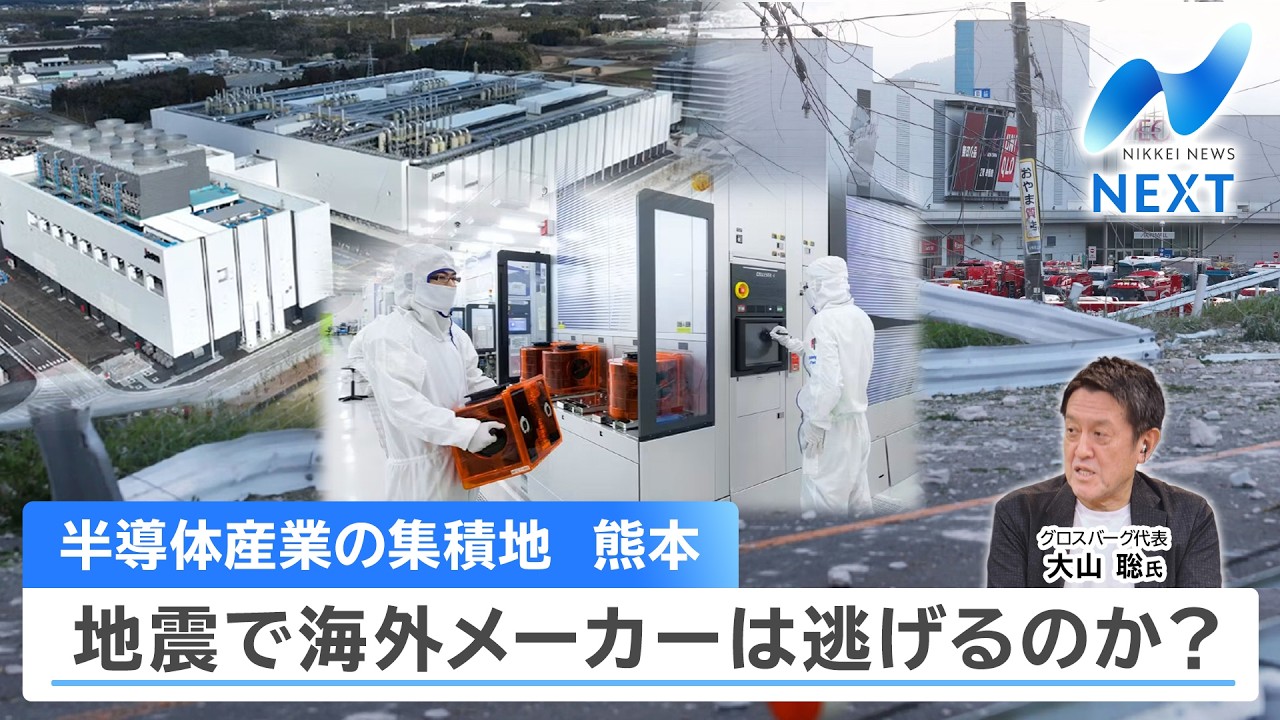
Japan also has a broad network of semiconductor manufacturers, materials suppliers and equipment makers. Although earthquakes are frequent, companies have developed extensive countermeasures, while labor costs remain relatively low compared with the United States. Taken together, those factors are likely to sustain overseas manufacturers' interest in expanding production in Japan rather than drive them away, Oyama said. The earthquake is nevertheless expected to reinforce the importance of business continuity planning, including measures to protect supply chains and restore operations quickly after natural disasters.

 
I asked ChatGPT about this issue and received the following response.

The 2026 Kumamoto Earthquake had a significant impact on Japan's semiconductor industry. Sony's Kumamoto semiconductor plant, one of the world's major image sensor production facilities, temporarily suspended operations due to damage to equipment, clean rooms, and infrastructure. The disruption affected global supply chains, especially smartphone camera sensor production.

The earthquake also highlighted the importance of earthquake-resistant semiconductor facilities and supply-chain diversification. The new TSMC/JASM Kumamoto fab was designed with stronger seismic measures, including advanced building structures, equipment protection, and backup infrastructure to reduce the risk of future disruptions.

Impact of the 2026 Kumamoto Earthquake on Japan's Semiconductor Industry

The 2026 Kumamoto Earthquake is unlikely to cause semiconductor companies to withdraw from Kumamoto on a large scale. The more likely outcome is temporary production suspension, safety inspections, equipment reinforcement, and continued operation.

Kumamoto remains a strategically important semiconductor hub because of its strong industrial foundation, including abundant groundwater resources, stable electricity supply, skilled workers, existing semiconductor companies, and close connections with suppliers. Large-scale semiconductor fabs require enormous investments in facilities, equipment, and human resources, making relocation extremely difficult and costly.

TSMC's Japan subsidiary, Japan Advanced Semiconductor Manufacturing (JASM), is especially unlikely to leave Kumamoto. The factory is a national strategic project supported by TSMC, Sony, and the Japanese government, and it plays an important role in strengthening Japan's semiconductor supply chain.

The main impact of the earthquake will likely be increased investment in disaster prevention. Semiconductor factories require extremely stable conditions, and even minor damage to manufacturing equipment, clean rooms, power systems, or water supplies can interrupt production. Companies are expected to improve earthquake resistance, backup systems, equipment protection, and supply-chain flexibility.

The earthquake may also accelerate Japan's strategy of diversifying semiconductor production across multiple regions:

Kumamoto: Mature-node logic chips, automotive semiconductors, and image sensors
Hokkaido : Advanced semiconductor production through Rapidus, including 2 nm logic chips
Tohoku: Memory chips, automotive semiconductors, and manufacturing equipment
Kanto: Semiconductor research, design, and testing
Chubu and Kansai: Semiconductor materials and production equipment

The experience of the 2016 Kumamoto Earthquake showed that semiconductor companies prefer recovery and reinforcement rather than withdrawal. Therefore, the 2026 earthquake is more likely to strengthen Japan's semiconductor resilience rather than weaken Kumamoto's role.

In conclusion, Kumamoto is expected to remain a key semiconductor production center. The earthquake will likely lead to stronger disaster preparedness and a more geographically diversified semiconductor supply chain throughout Japan.

Today, Japan is working to establish a production system for next-generation semiconductors, including AI chips equipped with NPUs (Neural Processing Units). The semiconductor fabs in Kumamoto, operated by TSMC through its subsidiary JASM, are primarily intended to manufacture mature-node semiconductors for existing applications, particularly the automotive and industrial sectors. Meanwhile, Japan is pursuing cutting-edge semiconductor production through the Rapidus project in Hokkaido, which aims to manufacture 2-nanometer logic chips for AI, high-performance computing, and future-generation processors. Together, these projects are strengthening Japan's semiconductor supply chain by combining stable production of conventional chips with the development of advanced semiconductor technologies.
 
Back
Top Bottom