News Volcanic eruption creates new isle in Ogasawara archipelago

thomas

Unswerving cyclist
Admin
Joined
14 Mar 2002
Messages
21,050
Reaction score
18,903
MSDF officials said a new islet has been formed by an undersea volcano in the Pacific Ocean, more than 1,000 kilometres south of Tokyo, as part of the Ogasawara island chain. The MSDF's air base on Iwoto Island, formerly known as Iwo Jima, reported on 1 November that they saw new land emerging about one kilometre from the island's south coast. The island's staff witnessed a loud sound, earth and sand flying into the sky, and verified the presence of the new isle, the MSDF said.
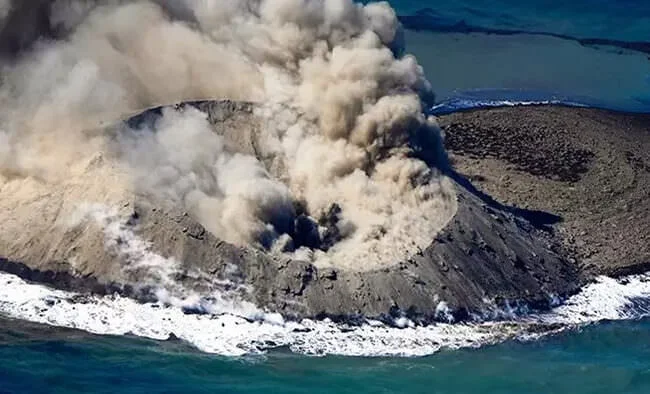
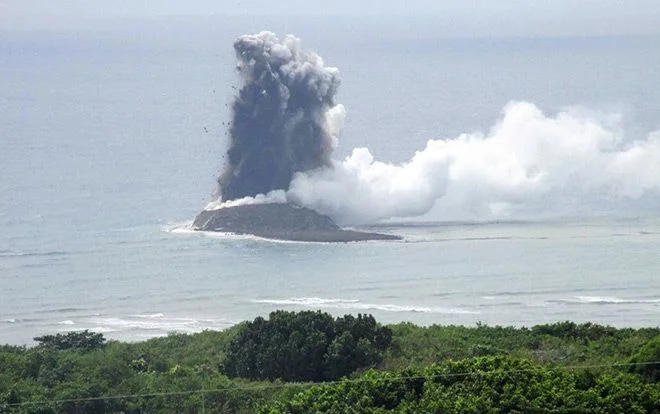
Iwoto.jpg


ada02d383dae5c984cbc7e18979a8a8a.jpg

Photo credit: Maritime Self-Defense Force
According to the Japan Meteorological Agency, volcanic tremors have been detected on Iwoto island every few minutes since around Oct. 21, followed by eruptions off the southern coast. The islet was formed near the crater of the undersea volcano. Iwoto island itself has been rising due to the volcanic activity. In June, pumice stones likely spewed by the volcano were found in the sea near the island. "It is possible that a large amount of rocks and stones ejected from the crater on the seafloor accumulated and created the islet," a JMA official said.


While most volcanic islands do not survive long, Asahi revisited Nishinoshima Island (西之島), located about 930 kilometres south of mainland Tokyo. Nininoshima has grown nearly 20 times larger in the past ten years.

520px-Nishinoshima_Island%2C_Ogasawara_Tokyo_Aerial_photograph._December_1%2C_2018.jpg

An aircraft chartered by Mainichi revisited the island last October.

9.jpg

Photo credit: Mainichi/Koichiro Tezuka

The 20th of November marks ten years since a series of eruptions created the new landmass near the former Nishinoshima Island, which belongs to the Tokyo village of Ogasawara. The new Nishinoshima grew larger due to eruptions, and the lava completely covered the former Nishinoshima. The island is still growing while erupting intermittently, and when seen in late October by a Mainichi Shimbun aircraft, an approximately 250-meter-high peak was seen at the top of the island in the Pacific Ocean. Nishinoshima was emitting discoloured water from the volcanic activity, turning the seawater brown and green. Localized fumarolic gas rose from the crater, but the island looked calm. According to Fukashi Maeno, volcanic geology associate professor of the Earthquake Research Institute at the University of Tokyo, who was on board the aircraft, the island's size has remained almost unchanged at about 4.4 square kilometres since August 2020, when an explosive eruption occurred.


Back
Top Bottom