

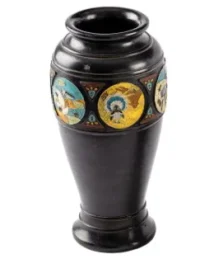
Our Powerhouse museum has a Tokonabe vase home decorating ware exported to the U.S. advertised by Sears Company in their 1928-1929 fall catalogue. Does anyone know any further information about this type of ware. I believe the name of the town changed from Tokonabe to Tokoname?
Navigation
Install the app
How to install the app on iOS
Follow along with the video below to see how to install our site as a web app on your home screen.
Note: This feature may not be available in some browsers.
More options
Style variation
System
Light
Dark
You are using an out of date browser. It may not display this or other websites correctly.
You should upgrade or use an alternative browser.
You should upgrade or use an alternative browser.
Tokonabe export ware vase c 1920-1930s
- Thread starter ClareBk
- Start date
- Thread starter
- #2
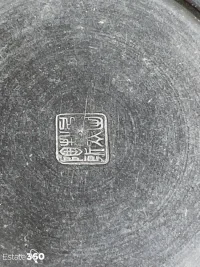
Can anyone please assist our museum deciphering the signature on the base of this export ware Tokonabe (Tokoname)?Our Powerhouse museum has a Tokonabe vase home decorating ware exported to the U.S. advertised by Sears Company in their 1928-1929 fall catalogue. Does anyone know any further information about this type of ware. I believe the name of the town changed from Tokonabe to Tokoname?

- 12 Oct 2013
- 4,071
- 5,023
久田製陶所 Hisata seitōsho (Made in the Hisata pottery/studio)
特許出願中 Patent pending (literally, "patent application submitted").
I just looked on Tokoname's wikipedia page, and it says nothing about the name ever being called/pronounced "Tokonabe". I think there might be some confusion as "nabe" literally means pot, so perhaps some people think there is an association between pots/pottery and the name of the place.
The name Tokoname apparently comes from the smooth texture of the clay found in the region. The second mora (the "name" in Tokoname) means smooth/slippery.
特許出願中 Patent pending (literally, "patent application submitted").
I just looked on Tokoname's wikipedia page, and it says nothing about the name ever being called/pronounced "Tokonabe". I think there might be some confusion as "nabe" literally means pot, so perhaps some people think there is an association between pots/pottery and the name of the place.
The name Tokoname apparently comes from the smooth texture of the clay found in the region. The second mora (the "name" in Tokoname) means smooth/slippery.
- 12 Oct 2013
- 4,071
- 5,023
The Japanese Wikipedia entry discusses the origin of the name briefly. The English version of the page doesn't mention it.

 ja.wikipedia.org
市名は土壌に由来するとされ、「常」は「床」(地盤)、「滑」は「滑らか」という意味である。古くからこの地は粘土層の露出が多く、その性質が滑らかなため「とこなめ」と呼び、そうした習俗が地名として定着していったと考えられている。
常滑市 - Wikipedia
市名は土壌に由来するとされ、「常」は「床」(地盤)、「滑」は「滑らか」という意味である。古くからこの地は粘土層の露出が多く、その性質が滑らかなため「とこなめ」と呼び、そうした習俗が地名として定着していったと考えられている。
- Thread starter
- #5
久田製陶所 Hisata seitōsho (Made in the Hisata pottery/studio)
特許出願中 Patent pending (literally, "patent application submitted").
I just looked on Tokoname's wikipedia page, and it says nothing about the name ever being called/pronounced "Tokonabe". I think there might be some confusion as "nabe" literally means pot, so perhaps some people think there is an association between pots/pottery and the name of the place.
The name Tokoname apparently comes from the smooth texture of the clay found in the region. The second mora (the "name" in Tokoname) means smooth/slippery.
Someone suggested that Hisada (surname) Seitosho (first name) was the name of the artist. What do you think? When I tried to translate the writing via Google it said it thought the writing was Chinese (Taiwan) and said made in Uta pottery factory Tian Jiu then I translated to Japanese and it came up with Uta Seitosho Taku. Agree with the patent pending. What are your thoughts?
- Thread starter
- #6
The exact same item was advertised on Estate 360 but had a stamped signature rather than an etched signature and called it Tokonabe ware.久田製陶所 Hisata seitōsho (Made in the Hisata pottery/studio)
特許出願中 Patent pending (literally, "patent application submitted").
I just looked on Tokoname's wikipedia page, and it says nothing about the name ever being called/pronounced "Tokonabe". I think there might be some confusion as "nabe" literally means pot, so perhaps some people think there is an association between pots/pottery and the name of the place.
The name Tokoname apparently comes from the smooth texture of the clay found in the region. The second mora (the "name" in Tokoname) means smooth/slippery.
Attachments
- Thread starter
- #8
Thanks Majestic, I agree that the Catalogue had made a mistake and that the auction houses just based their decision on that as it was the only information they could find. My Sensei also agrees with Seitosho being the place where pottery is manufactured. She seems to think that the pronunciation of the first word is Kyuta or Kuden. She was saying one of the symbols means long life. What do you think?Tokonabe would be a mistake.
Seitōsho isn't a first/given name. It literally means "place where pottery is manufactured".
- 12 Oct 2013
- 4,071
- 5,023
I think the most common pronunciation for 久田 is Hisada. As far as I know this will just be a normal surname, and its not going to have any deeper meaning. I mean, individually the character 久 means long (as in time span) and 田 means field, but any speculation about how this originated or if it is intended to have a spiritual significance would just be a wild guess. (I really think it is just a name without any particularly deep meaning).
Kyuden, Kuden, Kuta, Kyuta are all possible readings, but Hisada (or Hisata) are probably the most common readings.
Kyuden, Kuden, Kuta, Kyuta are all possible readings, but Hisada (or Hisata) are probably the most common readings.
- 12 Oct 2013
- 4,071
- 5,023
Just for reference (I don't know if its related to the maker of your item).

 www.tezumi.com
Japanese Matcha Bowl - 久田 貴久 Takahisa Hisada - 佳窯 Yoshi Kiln - Kohiki Glazed Tokoname-yaki Chawan - 300ml
This Tokoname-yaki chawan (matcha bowl) has a classic shape and is draped in an elegant kohiki glaze. This glaze produced a soft, matte white finish with a subtle gohonte pattern of pink spots and tiny black iron spots, charateristic of kohiki glazes. Made by Takahisa Hisada (久田 貴久) of Yoshi...
www.tezumi.com
- Thread starter
- #11
I agree, will go with Hisada. Thanks Majestic for confirming.I think the most common pronunciation for 久田 is Hisada. As far as I know this will just be a normal surname, and its not going to have any deeper meaning. I mean, individually the character 久 means long (as in time span) and 田 means field, but any speculation about how this originated or if it is intended to have a spiritual significance would just be a wild guess. (I really think it is just a name without any particularly deep meaning).
Kyuden, Kuden, Kuta, Kyuta are all possible readings, but Hisada (or Hisata) are probably the most common readings.
Similar threads

- Replies
- 72
- Views
- 9K