

Navigation
Install the app
How to install the app on iOS
Follow along with the video below to see how to install our site as a web app on your home screen.
Note: This feature may not be available in some browsers.
More options
Style variation
System
Light
Dark
You are using an out of date browser. It may not display this or other websites correctly.
You should upgrade or use an alternative browser.
You should upgrade or use an alternative browser.
The Aum Shinrikyo Thread
- Thread starter shao
- Start date

- 15 Mar 2002
- 16,758
- 2,298
Let's wait and see if this guy is going to be emplaced in a shrine
and get worship from Japanese after death penalty.
If not, then the so-called death worship tradition will be
completely hypocrisy and chicanery.
After reading your post, I glanced over at your flag and found myself thoroughly unsurprised.

shiroma
先輩
- 1 Mar 2004
- 481
- 18
Just twelve would be way too few for any enshrinement.Let's wait and see if this guy is going to be emplaced in a shrine
and get worship from Japanese after death penalty.
By the way how many did the great chairman Mao murder during the Great Leap Forward and Cultural Revolution to be admired at Tian'anmen Square.
- 15 Mar 2002
- 16,758
- 2,298
By the way how many did the great chairman Mao murder during the Great Leap Forward and Cultural Revolution to be admired at Tian'anmen Square.
He didn't murder anybody at all. That's just another one of those nasty myths, like the Rape of Nanking.
Are you sure Chinese people today still worship Mao?
In the eyes of most Chinese people, Mao is a dictator
and tyrant. he must be responsible for the death of
millions of poeple.
On the contrary, we have a neighbor, in there
killing 12 countrymen will be regarded as evil man
but killing millions of foreigner will be regarded as
national hero.
In the eyes of most Chinese people, Mao is a dictator
and tyrant. he must be responsible for the death of
millions of poeple.
On the contrary, we have a neighbor, in there
killing 12 countrymen will be regarded as evil man
but killing millions of foreigner will be regarded as
national hero.
Last edited:
- 15 Mar 2002
- 16,758
- 2,298
Are you sure Chinese people today still worship Mao?
In the eyes of most Chinese people, Mao is a dictator
and tyrant. he must be responsible for the death of
millions of poeple.
On the contrary, we have a neighbor, in there
killing 12 countrymen will be regarded as evil behavior
but killing millions of foreigner will be regarded as
national hero.
word of the day: "conflate"

leonmarino
Back
- 19 May 2006
- 1,258
- 64
What does that mean, conflate? 
- 15 Mar 2002
- 16,758
- 2,298
http://dictionary.reference.com/wordoftheday/archive/2004/08/04.html
gs001 conflates two entirely unrelated issues into one.
gs001 conflates two entirely unrelated issues into one.
shiroma
先輩
- 1 Mar 2004
- 481
- 18
It is nice that no poster in the thread so far has thought of the aspect that the minister of justice has not signed the official execution order paper because it could make Asahara a tragic martyr to attract more followers just like J***s C****t.
After all they will be unsuccessful in hanging him; the Guru supposedly can float in the air.
After all they will be unsuccessful in hanging him; the Guru supposedly can float in the air.
Hi! I have new info about Shoko Asahara, but can not add the link here 
I try to copy it here.
Shoko Asahara's trial
Osamu WATANABE
Will You Lead a Better Life If You Put Asahara to Death?
Yoshihiro YASUDA
The Right to Live
First-hand information in the books by notable Japanese lawyers Osamu Watanabe and Yoshihiro Yasuda
You have likely heard of Shoko Asahara and AUM Shinrikyo. These names are directly associated with the sarin gas incident in the Tokyo subway. A considerable number of people hold a definite opinion on the subject; of course, Shoko Asahara and his religious community deserve severe punishment. AUM's founder must be put to death for the crimes he has committed. The mass media had been trying very hard to suggest that Shoko Asahara was guilty even before the beginning of the trial. They created the image of Shoko Asahara, known to the public, and they helped to mould public opinion. Have you ever wondered whether this fabricated image might be incorrect and the trial's results predetermined?
We would like to bring to your attention the books by two notable Japanese lawyers: Yoshihiro Yasuda, chief attorney of Mr. Asahara, who is considered the country's leading advocate against the death penalty, and Osamu Watanabe. Neither were lawyers chosen by Mr. Asahara, but appointed by the state. They have never been interested in religion. They are good professionals who constantly strive to fulfil their professional duties in the best possible way, and honest men who were unable to remain silent about the outrageous violations of law and justice during Mr. Asahara's trial. This is why each of them independently regarded it as his duty to write a book to make the truth known to everybody. Their aim was not only to save Shoko Asahara's life but to serve the people of their country, fighting for lawful and fair trials.
You may change your opinion, moulded by the media, about the role Mr. Asahara played in the 1995 Sarin gas attack on the Tokyo subway, etc., after reading the books. You may also be shocked to learn from them the following facts:
The result of the trial was predetermined even before any investigation was started
The investigation authorities decided to execute Mr. Asahara even before they arrested him.
Not a single convincing evidence was presented in Court as proof of Mr. Asahara's guilt. All accusations were based on the deliberate distortion of AUM's doctrine and the evidence of some disciples [which cannot be considered reliable].
Investigation officials forged exhibits and coerced witnesses into lying. The objective expertise of the ツ'poisonous substance' found at the incident locations was not carried out.
The authorities were doing their best to remove lawyers from the way so they could execute the defendant. To achieve their goals during the investigation process, they arrested Yoshihiro Yasuda, the chief attorney of Shoko Asahara, who was acquitted on December 2. 24e began with the two chapters from the book by Osamu Watanabe, 'Will You Lead a Better Life If You Put Asahara to Death?'
One Response to "Shoko Asahara's trial"
Mary Kennedy Says:
March 23, 2011 2311:56 pm
Insight into the problems of terrorism today.
September 1999. Explosions of apartment houses in Moscow killed almost 300 people. This case will never be solved, so the real people who were behind the September 11 2002, terrorist attack in the US will never be revealed. Both of those terrorist acts have the exact nature, not only because in both cases, buildings exploded with civilians, but most of all because in both cases, wars with Chechnya or Iraq, places of origin for terrorists, became unavoidable. Undoubtedly, many people recognise that devastating cases provide a perfect platform for specific political actions, which are often based on economic interests. The official investigations in both cases lose their credibility over time, as contradictory facts, speculation, and evidence of alternative versions are refused to be examined by the authorities. But what is obvious is that in both of those cases of terrorism, there is a lack of ideological content.
The Gas attack in Tokyo underground in 1995 had no ideological content either, which leaves it open for any interpretation. As one analyst said, "In Japan, there never were any precedents of anonymous unmotivated massacre. The Gas attack in Tokyo was an attempt at anonymous mass, senseless murder of civilians (passengers of the underground) with the use of a genocidal weapon (fighting gas, Sarin). For the Japanese, this way of action is unthinkable! The gas attacks in Tokyo were planned by people whose brains are in a different political "culture". In which is the question?"
My attitude to this story from the beginning was that it must be clear to any logical person that such an attempt by Aum Shinrikyo to demonstrate power is useless and pointless. I would rather think of expanding the areas of political influence. I believe we have had enough lessons by now to be able to learn a few rules:
Terrorist attacks, which do not have an explicit ideological content, a responsible organiser surrounded by mystery and gossip, are appearing when politicians become limited in their influence in some areas or on some people. To understand the purpose of a terrorist attack, find the real political target. Who will be affected most of all by that attack? Keep up with the Mass Media. Often-repeated information in the news is what was meant to be achieved.
The creation of public opinion through mass media and politicians' speeches is a necessary step in realising fundamental ideas.
However, a few voices behind the chorus of shocking headlines can't change the fully formed public attitude to this crime. Osamu Watanabe is a man of noble personality whorganised thehe Aum Shinrikyo cult and was also the leader of the movement against the death penalty. In his book "Will You Lead a Better Life If You Put Asahara to Death?" he promulgated the sad fac,tstating that "thehe outcome of the court has been predeterminefromre the beginnirt."
Court philosopher-moralist Balthazar Garcia in the 17th century said: ツ "Do not yield to the first impression. Do not fill your senses with the first impression, or your mind with the first communication; this is the sign of shallow depth. There are people with the quality of that kind of crockery that absorbs the smell of the liquid it was first filled with, whether it was fragrant or foul. The bad thing is that others will learn about it - that is what the treachery needs: ill-intentioned people will hurry to colour your trusting nature in their colours. Let there always be a space for review of the opinion. Being at the mercy of the first impression is one step to a blind passion."
Another problem about us, ordinary people, is that we have a short memory. Not that many people today remember the announced goal of the American invasion of Iraq. No nuclear weapon was found, but thousands (not 12) of civilians were killed. We have short memories; we can forgive and forget the mistakes and sins of the past. However, forgiveness and forgetting are probably the biggest mistakes of our society today. This encourages the repetition of similar scenarios. The method of ruling the world through terrorism has become increasingly popular.
Asahara and his followers, along with the innocent civilians who were killed or injured by Sarin gas, are victims in this story. The reputations of some Russian politicians were also affected.
In Ireland, as in most European countries, Capital Punishment is revoked. Our Minister for Foreign Affairs, Dermot Ahern, giving his opinion on the Iraqi Court decision, described Saddam Hussein as a tyrant and murderer, but said only God can take life. The spiritual leader of the East, the Dalai Lama, said about that: 'I am against hanging.' You cannot achieve anything by violent means. Everyone needs peace.' In 2004, the Top Court in Japan sentenced to death Aum Shinrikyo's founder, Shoko Asahara. March of this year is the time when Asahara must be executed.
Two thousand years ago, Pilate asked the crowds, "What do you want me to do with Him?ツ" and they replied, "Crucify Him!" I believe that in the 21st century, humanity must be able to overcome the ignorance of crowds, which, when combined with the lack of morals prevalent today, can lead to very frustrating results. My letter is an appeal to Japanese people: "Virtue is wisdom", - Socrates said. I appeal to everybody in your country and the whole world – be virtues, be wise.
M.Kennedy
I try to copy it here.
Shoko Asahara's trial
Osamu WATANABE
Will You Lead a Better Life If You Put Asahara to Death?
Yoshihiro YASUDA
The Right to Live
First-hand information in the books by notable Japanese lawyers Osamu Watanabe and Yoshihiro Yasuda
You have likely heard of Shoko Asahara and AUM Shinrikyo. These names are directly associated with the sarin gas incident in the Tokyo subway. A considerable number of people hold a definite opinion on the subject; of course, Shoko Asahara and his religious community deserve severe punishment. AUM's founder must be put to death for the crimes he has committed. The mass media had been trying very hard to suggest that Shoko Asahara was guilty even before the beginning of the trial. They created the image of Shoko Asahara, known to the public, and they helped to mould public opinion. Have you ever wondered whether this fabricated image might be incorrect and the trial's results predetermined?
We would like to bring to your attention the books by two notable Japanese lawyers: Yoshihiro Yasuda, chief attorney of Mr. Asahara, who is considered the country's leading advocate against the death penalty, and Osamu Watanabe. Neither were lawyers chosen by Mr. Asahara, but appointed by the state. They have never been interested in religion. They are good professionals who constantly strive to fulfil their professional duties in the best possible way, and honest men who were unable to remain silent about the outrageous violations of law and justice during Mr. Asahara's trial. This is why each of them independently regarded it as his duty to write a book to make the truth known to everybody. Their aim was not only to save Shoko Asahara's life but to serve the people of their country, fighting for lawful and fair trials.
You may change your opinion, moulded by the media, about the role Mr. Asahara played in the 1995 Sarin gas attack on the Tokyo subway, etc., after reading the books. You may also be shocked to learn from them the following facts:
The result of the trial was predetermined even before any investigation was started
The investigation authorities decided to execute Mr. Asahara even before they arrested him.
Not a single convincing evidence was presented in Court as proof of Mr. Asahara's guilt. All accusations were based on the deliberate distortion of AUM's doctrine and the evidence of some disciples [which cannot be considered reliable].
Investigation officials forged exhibits and coerced witnesses into lying. The objective expertise of the ツ'poisonous substance' found at the incident locations was not carried out.
The authorities were doing their best to remove lawyers from the way so they could execute the defendant. To achieve their goals during the investigation process, they arrested Yoshihiro Yasuda, the chief attorney of Shoko Asahara, who was acquitted on December 2. 24e began with the two chapters from the book by Osamu Watanabe, 'Will You Lead a Better Life If You Put Asahara to Death?'
One Response to "Shoko Asahara's trial"
Mary Kennedy Says:
March 23, 2011 2311:56 pm
Insight into the problems of terrorism today.
September 1999. Explosions of apartment houses in Moscow killed almost 300 people. This case will never be solved, so the real people who were behind the September 11 2002, terrorist attack in the US will never be revealed. Both of those terrorist acts have the exact nature, not only because in both cases, buildings exploded with civilians, but most of all because in both cases, wars with Chechnya or Iraq, places of origin for terrorists, became unavoidable. Undoubtedly, many people recognise that devastating cases provide a perfect platform for specific political actions, which are often based on economic interests. The official investigations in both cases lose their credibility over time, as contradictory facts, speculation, and evidence of alternative versions are refused to be examined by the authorities. But what is obvious is that in both of those cases of terrorism, there is a lack of ideological content.
The Gas attack in Tokyo underground in 1995 had no ideological content either, which leaves it open for any interpretation. As one analyst said, "In Japan, there never were any precedents of anonymous unmotivated massacre. The Gas attack in Tokyo was an attempt at anonymous mass, senseless murder of civilians (passengers of the underground) with the use of a genocidal weapon (fighting gas, Sarin). For the Japanese, this way of action is unthinkable! The gas attacks in Tokyo were planned by people whose brains are in a different political "culture". In which is the question?"
My attitude to this story from the beginning was that it must be clear to any logical person that such an attempt by Aum Shinrikyo to demonstrate power is useless and pointless. I would rather think of expanding the areas of political influence. I believe we have had enough lessons by now to be able to learn a few rules:
Terrorist attacks, which do not have an explicit ideological content, a responsible organiser surrounded by mystery and gossip, are appearing when politicians become limited in their influence in some areas or on some people. To understand the purpose of a terrorist attack, find the real political target. Who will be affected most of all by that attack? Keep up with the Mass Media. Often-repeated information in the news is what was meant to be achieved.
The creation of public opinion through mass media and politicians' speeches is a necessary step in realising fundamental ideas.
However, a few voices behind the chorus of shocking headlines can't change the fully formed public attitude to this crime. Osamu Watanabe is a man of noble personality whorganised thehe Aum Shinrikyo cult and was also the leader of the movement against the death penalty. In his book "Will You Lead a Better Life If You Put Asahara to Death?" he promulgated the sad fac,tstating that "thehe outcome of the court has been predeterminefromre the beginnirt."
Court philosopher-moralist Balthazar Garcia in the 17th century said: ツ "Do not yield to the first impression. Do not fill your senses with the first impression, or your mind with the first communication; this is the sign of shallow depth. There are people with the quality of that kind of crockery that absorbs the smell of the liquid it was first filled with, whether it was fragrant or foul. The bad thing is that others will learn about it - that is what the treachery needs: ill-intentioned people will hurry to colour your trusting nature in their colours. Let there always be a space for review of the opinion. Being at the mercy of the first impression is one step to a blind passion."
Another problem about us, ordinary people, is that we have a short memory. Not that many people today remember the announced goal of the American invasion of Iraq. No nuclear weapon was found, but thousands (not 12) of civilians were killed. We have short memories; we can forgive and forget the mistakes and sins of the past. However, forgiveness and forgetting are probably the biggest mistakes of our society today. This encourages the repetition of similar scenarios. The method of ruling the world through terrorism has become increasingly popular.
Asahara and his followers, along with the innocent civilians who were killed or injured by Sarin gas, are victims in this story. The reputations of some Russian politicians were also affected.
In Ireland, as in most European countries, Capital Punishment is revoked. Our Minister for Foreign Affairs, Dermot Ahern, giving his opinion on the Iraqi Court decision, described Saddam Hussein as a tyrant and murderer, but said only God can take life. The spiritual leader of the East, the Dalai Lama, said about that: 'I am against hanging.' You cannot achieve anything by violent means. Everyone needs peace.' In 2004, the Top Court in Japan sentenced to death Aum Shinrikyo's founder, Shoko Asahara. March of this year is the time when Asahara must be executed.
Two thousand years ago, Pilate asked the crowds, "What do you want me to do with Him?ツ" and they replied, "Crucify Him!" I believe that in the 21st century, humanity must be able to overcome the ignorance of crowds, which, when combined with the lack of morals prevalent today, can lead to very frustrating results. My letter is an appeal to Japanese people: "Virtue is wisdom", - Socrates said. I appeal to everybody in your country and the whole world – be virtues, be wise.
M.Kennedy

- 5 Feb 2005
- 7,694
- 627
TOKYO – A member of the doomsday cult behind a deadly Tokyo subway gas attack and other crimes turned himself in to police after 17 years on the run, an official said Sunday.A Tokyo metropolitan police official said Makoto Hirata, a member of Aum Shinrikyo, conspired with several other members in kidnapping a notary official in 1995 and causing his death. The victim, Kiyoshi Kariya, then 68, was the brother of a follower trying to quit the group.Hirata, 46, who had been on the run since the summer of 1995, turned himself in at a Tokyo police station and was detained early Sunday, the police official said on condition of anonymity.The cult also released sarin nerve gas in Tokyo's subway system in 1995, killing 13 people and injuring more than 6,000 in Japan's deadliest act of domestic terrorism...
Public broadcaster NHK said Hirata told police he wanted to "put the past behind him." He was carrying a travel pack containing minimal daily necessities and had Japanese currency worth several hundred dollars in his wallet, it said.
Nearly 200 members of the cult have been convicted in the gas attack and dozens of other crimes. Thirteen, including cult guru Shoko Asahara, are on death row. No one has been executed.
Japan cult member nabbed after 17 years on the run - Yahoo! News
Wish there where more criminals like him that turn themselves in like this. I do wonder if his punishment be reduced because of this?
I also wonder what they will do with the other 13 members that are on death row.
- 15 Mar 2002
- 16,758
- 2,298
The statute of limitations was 15 years (maximum) at the time of his crimes and it is doubtful he can be charged with any of them.
The statute of limitations on murder charges was recently eliminated, but I don't know if that was retroactive or not. If not, he is probably as free as a bird.
The statute of limitations on murder charges was recently eliminated, but I don't know if that was retroactive or not. If not, he is probably as free as a bird.

KirinMan
後輩
- 23 Jan 2007
- 2,173
- 68
I also wonder what they will do with the other 13 members that are on death row.
I think that eventually these will either die in prison of a quick stop after a short drop, or of natural causes. I would think that the word parole is not in their lexicon either.
Basically I guess I need to come up with a thesis. I'm going make a video presentation, and for primary information i'm hoping to extract clips of Aum members stating their opinions about the world and themselves.
Japan - Aum Supreme Truth Cult - YouTube
So what is this guy saying? Is he saying exactly what the narrator was saying right before? that he was disillusioned from Japanese education system?
Japan - Aum Supreme Truth Cult - YouTube
So what is this guy saying? Is he saying exactly what the narrator was saying right before? that he was disillusioned from Japanese education system?
hmm.. I think I'm just going to make a PPT presentation and link to a certain time within the videos...
my draft is due this evening by the way, it might be a little late when I finish by about 9 to 10 o clock or even midnight.. T T
I know very little Japanese.
Anyway what I've been wondering is, if they were attracted because of the asceticism, couldn't they have just went to an ascetic Buddhist monastery in Japan? or even a Trappist monastery in Japan? Or perhaps they were attracted to Aum because they were advertising /recruiting vigorously while Buddhist monasteries are not recruiting people?
my draft is due this evening by the way, it might be a little late when I finish by about 9 to 10 o clock or even midnight.. T T
I know very little Japanese.
Anyway what I've been wondering is, if they were attracted because of the asceticism, couldn't they have just went to an ascetic Buddhist monastery in Japan? or even a Trappist monastery in Japan? Or perhaps they were attracted to Aum because they were advertising /recruiting vigorously while Buddhist monasteries are not recruiting people?

- 14 Mar 2002
- 21,053
- 18,908
After more than two decades of detention and twelve years on death row, Aum Shinrikyo founder Shoko Asahara and six other condemned Aum members were executed today at the Tokyo Detention House in Katsushika.
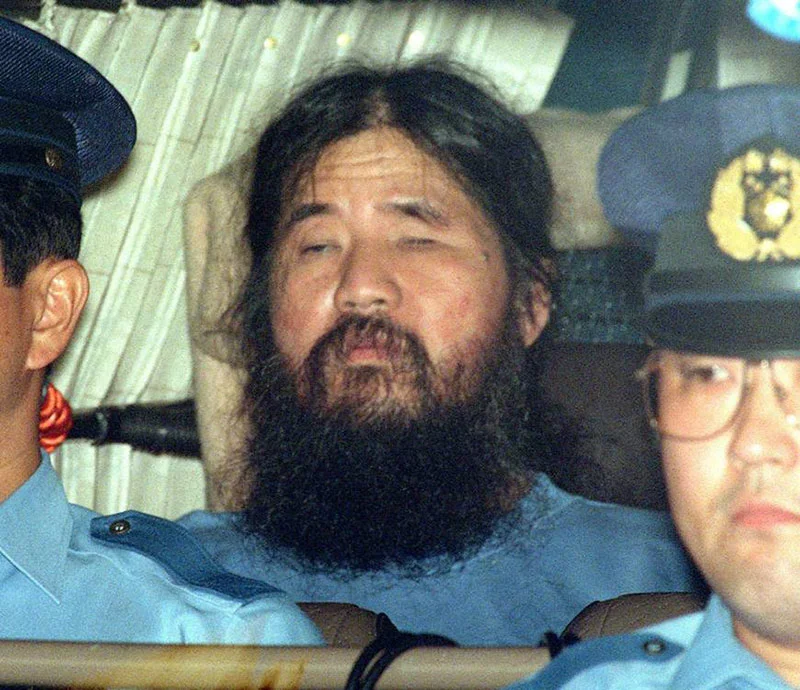
Asahara in 1995 (photo credit: Kyodo)
Aum Shinrikyo guru Shoko Asahara and six other cult members hanged for mass murders: officials | The Japan Times
Aum founder Matsumoto, top disciples hanged for sarin attacks:The Asahi Shimbun
Asahara unresponsive to calls from guards, but could walk, eat on own before execution - The Mainichi
Here's our article on Aum Shinrikyo:
Aum Shinrikyo | Japan Forum
Asahara in 1995 (photo credit: Kyodo)
Aum Shinrikyo guru Shoko Asahara and six other cult members hanged for mass murders: officials | The Japan Times
Aum founder Matsumoto, top disciples hanged for sarin attacks:The Asahi Shimbun
Asahara unresponsive to calls from guards, but could walk, eat on own before execution - The Mainichi
Here's our article on Aum Shinrikyo:
Aum Shinrikyo | Japan Forum

- 4 Sep 2015
- 2,306
- 1,906
I wonder if he went out mumbling like he did in his court hearings.
They did hang him, right?
They did hang him, right?
- 14 Mar 2002
- 21,053
- 18,908
All that's been reported is that he was cremated today and that there seems to be a family feud over his remains:
Family feud rises over remains of executed Aum Shinrikyo guru:The Asahi Shimbun
Family feud rises over remains of executed Aum Shinrikyo guru:The Asahi Shimbun

- 8 Aug 2005
- 7,316
- 3,727
For some reason I thought they had executed him much earlier. Was the delay for ensuring some kind of due process (an appeal is mentioned in the JREF article mentioned above, which is quite informative), or is removing the certainty of knowing your execution date a part of the death penalty punishment in Japan?
Similar threads

- Replies
- 112
- Views
- 19K


