Summertime, pet bug season

thomas

Unswerving cyclist
Admin
Joined
14 Mar 2002
Messages
21,050
Reaction score
18,903
Yuri Kageyama on why specific bugs are popular pets in nature-loving Japan.

The pet of choice in Japan, as much as cuddly kitties and playful puppies, is the humble bug. The bug has been a key part of Japanese culture from the Heian era classic "The Tale of Genji" to popular modern-day manga and animation like "Mushishi," featuring insect-like supernatural creatures. Japanese people appreciate the glitter of fireflies let loose in the garden or the gentle chirping of crickets kept in a little cage. You can feed the bug pets watermelon, but special jelly pet food for bugs is also available at stores. Naturally, bugs are on sale as well, with the more esoteric ones selling for 20,000 yen ($133).

Japan differs from much of the West in encouraging interaction with bugs from childhood, with lots of books written for children, as well as classes and tours. "In Japan, kids love bugs. You can even buy a net at a convenience store," he said. "It's fantastic that bugs can serve as a doorway to science." The fact some insects go through metamorphoses, transforming from a larva to a butterfly, for instance, adds to the excitement, allowing kids to observe the stages of a life span, Maruyama said.


Kabutomushi, in particular, are popular. They are all over, battling it out in the trees. From our local park:
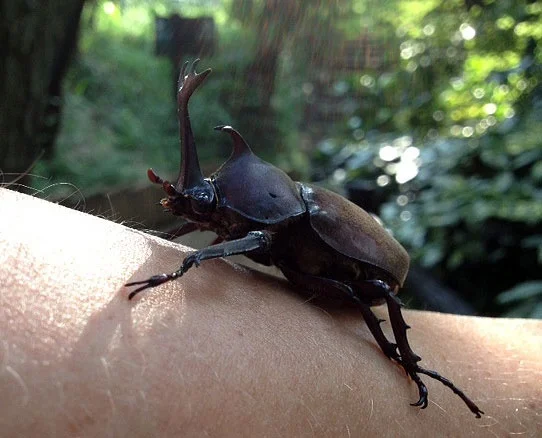
 
I dislike insects, so when I was a child, I didn't want to go insect collecting. But since "bug catching" was a typical summer activity and a common thing at home, I reluctantly went out with my friends to shrines and forests to catch cicadas and beetles. One of my friends was a true insect enthusiast and would passionately talk about The Life of the Fly by Jean-Henri Fabre.

 
Somehow my wife didn't get the memo. She hates bugs with a passion. She even hates butterflies because they are bugs. But she's fine with spiders and snakes. 🤷‍♂️
 
That's quite a woman! I would have thought at least spiders would be lumped in with bugs.

I knew a lot of boys that had pet insects, but I honestly can't recall if I knew any girls with them. It could be a "boy" thing.
 
Beetles at Work at the Request of His Eldest Son: Breeder Raises and Sells About 20,000 Beetles a Year, "Bringing Smiles to Many" — Kagoshima
(MBC News Now, Broadcast June 17, 2025)


One of the things that remind us of summer is the beetle. This man is a breeder who raises and sells more than 20,000 beetles a year, both at his home and elsewhere. We interviewed him about his work, which aims to bring smiles to both children and adults through beetles.
(Masaki Tani) "This is a Caucasus beetle. The length of its horn, and giving it a slightly rounded shape, is difficult."
Masaki Tani, 34, lives in Kagoshima City. He runs a company that breeds and sells about 22,000 beetles and stag beetles a year, both native Japanese species and foreign ones. On the second floor of his home, there is a room not only for his children but also dedicated to raising beetles.
There are Hercules beetles, known as the largest in the world and as big as an adult's palm, and Caucasus beetles, distinguished by their three long horns. There are even adult Japanese rhinoceros beetles, which aren't typically seen at this time of year.
(Masaki Tani) "It's hot in here, you know."
The room is kept around 25°C thanks to air conditioning, creating an environment where beetles can be raised year-round.
(Masaki Tani) "It's fun. It's the best. Even the size of the larvae changes depending on the soil — it's really deep and fascinating."
Tani became a breeder nine years ago when his then three-year-old eldest son, Emu, begged him, "I want to raise beetles." Wanting to make it special, he splurged on a pair of Hercules beetles, which cost about 40,000 yen at the time. Teaching himself how to raise them, he successfully bred them and gradually increased their numbers.
(Masaki Tani) "I wasn't really good with beetles at first, but if my child liked them, I had no choice but to handle them. I taught myself using books and online resources, and now I've finally established my method."
"I'm home!"
Emu, now a middle school student, rushes to the beetle room on the second floor after quickly finishing his homework. "I give them bananas, spray them with water, and put them back. It takes about an hour and a half."
Q: Do you ever not feel like taking care of them?
"No."
Q: What do you think is cool about them?
"The horns."
Interestingly, Tani was a hairstylist until seven years ago. He now cuts his family's hair at home.
(Masaki Tani) "How's my haircut?"
(Emu) "Normal."
(Masaki Tani) "The kids have never been to a salon. They don't even know it costs money."
In 2018, Tani quit being a hairstylist and joined a nonprofit organization run by his mother, "Yume no Sato," which provides continuous employment support. There, he started assigning beetle care to people with disabilities.
(Masaki Tani) "I've been doing this for five or six years now."
(Yurika Machida, 32) "At first, I was worried because I'm not good with insects, but somehow I grew attached to them."
Machida has been responsible for the beetles for about six months. Previously, she mainly did tasks like folding boxes for nearby confectionery stores. She now uses the beetles she raises for events where children can interact with them. Drawing on her customer service experience, she finds her current work fulfilling.
(Yurika Machida) "Children ask unique questions, and while answering them, I learn too. Seeing them smile through the beetles makes me feel it was worth raising them."

The average monthly wage at continuous employment support facilities in the prefecture is about 80,000 yen for type-A employment. In contrast, type-B employment, where people work at their own pace, averages only about 26,000 yen. Tani aims to increase wages for facility participants through his beetle business, helping them find fulfillment in work.
(Masaki Tani) "Wages are the biggest challenge in type-B employment. Some people here earn wages comparable to type-A. I think we can improve pay by considering unit prices and how much they can earn."
"Soft and squishy," Tani visited Seiwa Elementary School last month, where he has been donating beetle-raising kits to the school for three years.
(3rd-grade student) "I want to raise them cutely."
(Masaki Tani, owner of the beetle breeding and sales company) "I want kids to enjoy it, learn about life and ethics, and have fun. Seeing their joyful faces when they visit is extremely rewarding and brings me personal joy too."
Through his beetles, Tani experiences the fulfillment of work and the preciousness of life. His activities, bringing smiles to many, will continue.
Tani and his team hold annual summer events where children can interact with beetles. This year, the event will be held on July 20 and 21 at Green Farm in Kiire, Kagoshima City.
 
[Beetles as Saviors!?] Twin Brothers Discover a CO₂ Reduction Method — Could Solve Waste Disposal and Food Supply Issues

"The extreme heat is bringing terrifying consequences. Humanity has opened the gates of hell."
In July 2023, UN Secretary-General António Guterres issued this warning at a press conference.
The Earth is facing a critical crisis — not just global warming, but what he called the "era of global boiling." Record-breaking heat continues, with Japan's average temperature hitting historic highs for two consecutive years.
As urgent measures are needed, a surprising creature is now drawing attention.
That creature is… the rhinoceros beetle!
"Its wings are really beautiful, and if we're talking about cuteness, I love the little hairs under its horn," says Yosuke Ishida (27), a self-proclaimed beetle enthusiast.
Yosuke, along with his twin brother Kensuke, grew up loving rhinoceros beetles. Together, they launched TOMUSHI, a startup specializing in insect-related ventures.
According to Yosuke, when they began breeding beetles seven years ago, they stumbled upon an astonishing discovery.
Yosuke Ishida, CEO of TOMUSHI:
"By feeding beetles a certain material, we realized they could actually help solve problems humans have been struggling with. We only discovered this once we tried it ourselves."
So, what exactly do rhinoceros beetles eat, and how do they solve such problems?
The answer lies in Ookimachi, Fukuoka Prefecture, one of Japan's top mushroom-producing regions.
Here, shimeji mushrooms are cultivated. But a major challenge has long been the disposal of kinshō—the mushroom culture bed made primarily from sawdust.
Factory representative:
"There's no use for it. We end up just burning it. Around 100 tons of waste is produced every month."
Incineration releases huge amounts of CO₂.
Enter the beetle.
When the waste culture bed is ground up and fed to rhinoceros beetle larvae, there's no need to burn it, reducing CO₂ emissions by as much as 95%—down to one-twentieth.
The larvae's droppings, produced in abundance, can then be used as fertilizer. What's more, experiments are underway to use powdered larvae as feed for farmed fish.
In short, the "power of beetles" has the potential to address not just global warming, but also waste management and food supply challenges.
But the Ishida brothers' journey has not been without obstacles.
Yosuke recalls:
"One winter, a power outage struck. If the room temperature dropped, all the beetles we were raising could die. So my brother and I moved around through the night, raising our body heat and using it to keep the room warm, desperate to save them."
However, Kensuke has since chosen a different path.
In September 2024, he ran for mayor of his hometown, Ōdate City in Akita Prefecture—and won. At 27, he became the youngest mayor in Japan, leaving the company in Yosuke's care while dedicating himself to tackling local issues.
Still, both brothers' lives have been transformed by their love of beetles.
Even their company car is painted in rhinoceros beetle colors, and at events, they proudly showcase beetle-inspired decorations.
Today, TOMUSHI has expanded its waste-reduction system to 80 sites nationwide.
Yosuke Ishida:
"For us, it's about waste management and utilizing unused resources. The beetles are working incredibly hard. I always feel grateful—'You've done well, now carry this on to the next generation.'"
Rhinoceros beetles aren't just cool-looking creatures—they may hold the key to protecting Earth's environment.


Last updated: June 14, 2025, 13:00
 
Back
Top Bottom