News NPA to introduce fines for bicycle traffic offences

thomas

Unswerving cyclist
Admin
Joined
14 Mar 2002
Messages
21,050
Reaction score
18,903
That's something preached for years and a step in the right direction: the National Police Agency will introduce fines for cyclists who run a red light or ignore a stop sign to crack down on bicycle traffic violations that do not lead to severe consequences.

👏👏👏


The monetary penalties would be administrative, the same as a motorist paying a traffic ticket. Currently, bad cycling can only be met with criminal penalties, which may be excessive in cases where no injury, damage or disruption results. The NPA plans to submit a bill to revise the Road Traffic Law to the ordinary Diet session next year. It will do so after it receives a recommendation from a panel of experts by the end of the year. The NPA will discuss what types of minor traffic violations would be subject to the proposed administrative penalties. The change would more or less align the penalty system for cyclists with that for motorists. Vehicle drivers are exempted from criminal penalties for minor traffic violations if they pay administrative penalties under the traffic infraction notification system. They are served a blue ticket for such offenses.
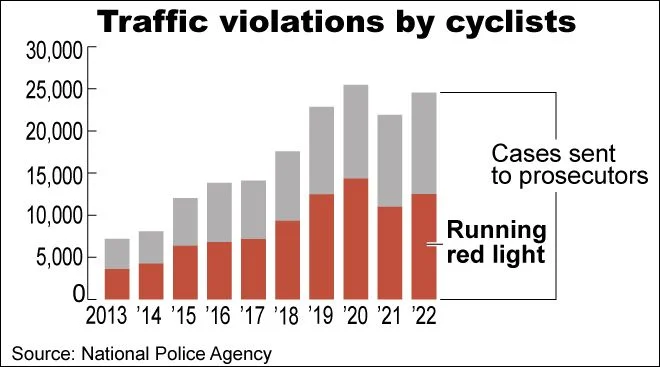
The NPA also plans to cover cyclists through the traffic infraction notification system.

👏


c3bb7fe549ae3d3a139e25a9cbbe7c9d.jpg


I got stopped last weekend by the police because one I'm not a Japanese too I look like I was a homeless thief still in a bicycle and three I end up shaking the police officers hand for stopping me.
Actually had a nice conversation with them because I know what it is to have a bicycle stolen and he was pretty cool he spoke English so that was pretty cool.
 
The proposed revisions to Japan's Road Traffic Act, approved by the Cabinet on 5 March, would allow police to issue tickets to cyclists for minor traffic violations. Under these revisions, bicycles would be included in the existing traffic penalty system, where police issue "blue tickets" for such violations. Violators would be required to pay a fine. If the Diet enacts the revised law, it will take effect within two years of its promulgation. The amendment specifies 112 types of traffic violations, including ignoring traffic signals and stop signs. Additionally, action will be taken in cases of malicious and dangerous behaviour, such as failure to obey instructions and warnings from police officers and obstruction of pedestrians and other traffic.

Blue ticket enforcement will apply to cyclists aged 16 and over. [...] In principle, when a police officer confirms a violation, they should first give guidance and warnings. However, they may immediately issue a blue ticket for dangerous acts, including cutting in front of a person on a pedestrian crosswalk or running a red light or stop sign while using a mobile phone. [...] The fine amounts will be set by government ordinance, but most penalties are expected to be between 5,000 yen and 6,000 yen (about $33 to $40), the same as those for motorized bicycles. Riding while intoxicated, which is highly dangerous, will be subject to a "red ticket," which is a procedure to impose criminal penalties.

 
The Japanese parliament has approved a new measure allowing law enforcement to impose fines on bicyclists for minor infractions, a move prompted by the surge in cycling-related mishaps that paralleled the uptick in bicycle commuting during the COVID-19 outbreak. With the updated Road Traffic Act, individuals 16 years and older can receive "blue tickets" for approximately 115 less severe breaches, such as disregarding traffic signals and halt signs. Previously, cyclists could only be cited with "red tickets" for around 20 major violations, like cycling under heavy intoxication, which necessitated inquiries potentially leading to legal proceedings, thus overburdening the police and the violator.


The amended law expanded the range of red ticket offenses to include cycling above the established road alcohol driving limit or posing a danger to traffic by using a mobile phone while riding. Blue ticket fines are expected to range between around 5,000 yen ($32) and 12,000 yen. If convicted, those found cycling under the influence and issued a red ticket could be subject to imprisonment of up to three years or a fine of 500,000 yen, and those cycling while using a phone could be given a prison term of up to one year or a 300,000 yen fine.

 
As a full time cyclist here in Yamaguchi people are quite thoughtful of us cyclist, but really the govt should put a one million yen fine for drivers talking on the freak'n phones. I'm serious about this also.
 
As a full time cyclist here in Yamaguchi people are quite thoughtful of us cyclist, but really the govt should put a one million yen fine for drivers talking on the freak'n phones. I'm serious about this also.
We have a lot of 'crotch-watchers' driving here in Denmark, ie. they have their phones in their laps and if the police pulls them over they just spread their legs and sit on their phone. It's such a disregard for everyone else's safety, I wish the punishment were stricter. I honestly feel it should be punishable with a temporary driving ban and the need for a new driving test.
 
The NPA announced today that the government intends to amend the road traffic ordinance to allow on-the-spot fines for cyclists who commit traffic violations. The revised regulations, which will detail specific offences and corresponding penalties, are scheduled to take effect on 1 April 2026, following a public consultation period from 25 April to 24 May. Comments can be submitted via the agency's website, email, or post.

Fines will be similar to those imposed on moped users, with more serious infractions—such as using a smartphone while cycling—incurring penalties of up to ¥12,000.

The new rules, also known as the blue-ticket system, let police officers issue fines on the spot to cyclists for relatively minor violations, with offenders able to avoid criminal prosecution if the fine is paid. Until now, police have typically responded to cycling violations by issuing verbal warnings or, in severe cases, handing out red tickets, which can lead to prosecution. However, since most red-ticket cases do not lead to indictment, the system has been criticised as ineffective.

Under the proposed enforcement order, cyclists aged 16 and above may be fined for any of 113 different violations, most of which correspond to those applied to moped users. These include offences such as running a red light, which carries a penalty of ¥6,000, and failing to obey a stop sign, punishable by a ¥5,000 fine.

In addition, four offences are specific to bicycles, including riding a fixed-gear bike without brakes (¥5,000) and carrying a passenger on a bicycle not designed for two people (¥3,000). More serious infractions—such as cycling under the influence of alcohol or engaging in obstructive or aggressive riding—will continue to fall under the red ticket system. Blue tickets are expected to be issued primarily in cases where cyclists ignore police warnings or present a clear danger to others.


Looks like tandem bikes are now permissible.
 
I'm only a casual cyclist, what does "riding a fixed-gear bike without brakes" mean? Is "fixed-gear" similar to coaster brakes where you petal backwards to brake instead of having hand operated brakes?
 
I'm only a casual cyclist, what does "riding a fixed-gear bike without brakes" mean? Is "fixed-gear" similar to coaster brakes where you petal backwards to brake instead of having hand operated brakes?
I think you're right there - they're the sort of bikes that are used for racing in velodromes.
 
The bicycle fines were on the news yesterday. I commented to my wife that practically every drama with young protagonists show them in a scene bicycling with the girl on the back. I'm guessing they won't be depicting that so much any more. I couldn't find pictures of young ones doing it but here's a picture of seniors doing it.

1745587415924.webp
 
The bicycle fines were on the news yesterday. I commented to my wife that practically every drama with young protagonists show them in a scene bicycling with the girl on the back. I'm guessing they won't be depicting that so much any more. I couldn't find pictures of young ones doing it but here's a picture of seniors doing it.

I'm sure you had something like this on your mind.

anime-futari-unten.webp


A few days ago, a new program reported on "kasa-unten," riding a bicycle while holding an umbrella—a practice often seen during the rainy season in Japan—that poses significant danger, as seen in the video below.

[ Video deleted ]​

Under revisions to the Road Traffic Act taking effect in April 2026, cyclists caught holding umbrellas while riding will face a fine of 5000 yen. The dangers are not hypothetical. Accidents have already occurred as a result of this practice. Footage captured by a car's dashboard camera on a clear road shows a collision moments after the vehicle passes through an intersection. A cyclist riding while holding an umbrella suddenly emerges from between oncoming cars and crashes. Riding with an umbrella obstructs vision and destabilizes steering and balance, significantly increasing the risk of accidents. According to a test conducted by the Japan Automobile Federation (JAF), the stopping distance for a cyclist riding correctly was measured at a designated point marked by red pylons. When the cyclist held an umbrella, the braking distance extended by nearly one meter.

 
Last edited:
From my study, I can see students passing by on their way to school. The junior high school students are wearing helmets, but the high school students just carry them in their hands without wearing them. Of course, none of the adults wear helmets. In a few years, everyone will probably be wearing helmets.
 
The accident at about 0:55 in the video seems only marginally related to the student having an umbrella. The student pulled out to cross (in the wrong place), but did stop after doing so. I'll guess that the insurance companies can reconstruct the car's speed--I can't suggest a number, but they seemed to be cruising along faster than I'd go. There may be a speed limit sign (up high) just before passing the bus, but I can't make it out. Roads like this might be 40km/hr, maybe 30.

And I'll also say that the car driver, while they did brake, (1) didn't hit the brakes full on for a true emergency stop. (2) There was/is plenty of space on the left--no curbs or poles, etc--where the driver could also have veered left while braking, since the kid was already stopped. Maybe a complete miss, or much less contact with the bike and not hitting/throwing the kid like it did. (I've watched at 0.5 and 0.25 speed.)

I'd estimate there are about four car lengths from when I first see the kid to contact. The driver was caught unawares and did not brake hard enough, nor even in the smallest way try to veer left.

The kid was wrong to pull out/cross there, but they had stopped completely. Vehicles are supposed to be in control of the driver, and technically/legally the car should be able to stop so as to avoid this kind of thing. In the US, the kid might be at fault, since the driver had the right of way; here, with shared responsibility, I think the driver will get pegged for most of it.--they hit a stationary obstruction (person!) in the road because they didn't maintain control of their vehicle. It could have as easily been a pedestrian crossing there.
 
Fines for minor bicycle traffic offences—commonly referred to as "blue tickets"—are set to take effect from 1 April next year, with penalties ranging from 3,000 yen (approximately $21) to 12,000 yen. These fines will apply to cyclists aged 16 and over.

The final amounts were officially confirmed following a month-long public consultation period, which ran from 24 April to 24 May, regarding proposed revisions to the Cabinet ordinance enforcing the Road Traffic Law. Specific penalties include a 12,000 yen fine for riding while distracted by a smartphone or similar device, 6,000 yen for cycling against traffic or riding on pavements, and 3,000 yen for riding two abreast or carrying a passenger on a single bicycle.

  • Using a smartphone or other devices while cycling—12,000 yen
  • Entering a blocked railroad crossing—7,000 yen
  • Ignoring traffic lights—6,000 yen
  • Ignoring traffic divisions (such as driving the wrong way or riding on the sidewalk)—6,000 yen
  • Failing to stop temporarily at a designated location—5,000 yen
  • Cycling without lights at night—5,000 yen
  • Cycling with defective brakes or without brakes—5,000 yen
  • Violation of Public Safety Commission rules, such as riding a bicycle while holding an umbrella or not being able to hear necessary sounds because of earphones—5,000 yen
  • Obstructing an emergency vehicle—5,000 yen
  • Riding with two or more bikes side by side, riding a bicycle with two people—3,000 yen


The NPA explains new cycling fines in its bicycle rulebook:

Reckless cyclists in Japan will be subject to a new penalty system starting next April. And the National Police Agency has released a rulebook to help people get up to speed with the changes. Minor violations will be subject to "blue ticket" fines of between 3,000 and 12,000 yen. Police will generally respond to first-time offenders with guidance or a warning and issue tickets for repeat transgressions. The blue tickets apply to individuals aged 16 or older and will be issued for 113 violations. Offenders who pay will not face criminal punishment. Tickets will be issued immediately for aggressive or dangerous acts. They include using a cell phone while cycling, which will be subject to a fine of 12,000 yen, or about 82 dollars. Entering a railroad crossing when the barriers are down will result in a fine of 7,000 yen, or about 48 dollars.


自転車への交通反則通告制度(青切符)の導入ー【自転車ルールブック】
 
[Close Coverage] Crackdown on Bicycle Violations – "A Trap Just to Meet Quotas," Riders Complain… Excuses from Rule-Breaking Cyclists / Stricter Penalties in Place, Yet Smartphone Use While Riding Persists – The Reality Behind Malicious Offenses [The Real Story] <Kantele NEWS>

Traffic violations by cyclists have sharply increased in recent years.
Some riders ignore warnings from police officers altogether.
The streets are overflowing with nuisance cyclists who refuse to follow the rules!
Last year, penalties for cycling under the influence were toughened.
But when one man was caught, he responded with an attitude of indifference:
"Why did you drink today?"
"Because I was bored," he said nonchalantly.
So, what's the real reason behind these "nuisance cyclists" breaking the law?
Why can't they follow the rules? We investigated.
Kantele "News Runner" broadcast on June 11, 2025
 
[Danger] Accidents Reported as "Reckless Bicycles" Run Rampant in Kyoto… Unaware Foreign Tourists Also at Fault [Sun! Shine News]

[ Video deleted ]

"Sun! Shine" follows up on a growing problem in central Kyoto .
On certain stretches of Shijo Street and Kawaramachi Street, bicycle traffic is partially restricted due to heavy traffic and safety concerns.
However, these rules have not taken hold among many foreign tourists, and dangerous situations continue.
What did our stakeout investigation at the intersection of these two streets reveal?
("Sun! Shine" broadcast on September 4, 2025)


Reckless Bicycles Rampaging Through the Ancient Capital of Kyoto – Accidents on the Rise, Cyclists Ignoring Traffic Bans and Rules – Foreign Tourists Unaware of Regulations Also at Fault

In the tourist-packed ancient capital of Kyoto, where inbound visitors flock, accidents involving bicycles—particularly rental bikes—continue to occur.
In late July, on a road in Kyoto City, a city bus was forced to brake suddenly to avoid a collision with a bicycle. A female passenger fell inside the bus and fractured a bone. Many tourists, unaware of traffic restrictions, are also riding into no-bicycle zones.
With Kyoto's flat terrain making cycling easy, dangerous riding has increased. The Kyoto Prefectural Police are now tightening patrols.
[Photo] An officer from the Prefectural Police's Bicycle Enforcement Unit (Be-Unit) stops a rider cycling with earphones through a prohibited zone.
Unaware Riders Entering Restricted Areas
"Hey, watch out! Bicycles aren't allowed here!"
On Shijo Street, one of Kyoto's busiest main avenues filled with taxis and private cars heading toward tourist spots, a police officer from the Kyoto Prefectural Police shouted loudly.
Turning around was a surprised foreign tourist, confused and asking why he was being stopped.
The crackdown was being carried out by the Bicycle Enforcement Squad—nicknamed Be-Unit—established in April last year within the traffic division of the Prefectural Police. Officers patrol mainly the narrow streets and one-way roads of central Kyoto, riding bicycles themselves to monitor reckless riders and e-scooter users.
Although regular crackdowns are conducted on Shijo Street, violations continue daily.
Because Kyoto's city centre is flat, bicycles are used everywhere, making the prevention of accidents between cars and bicycles one of the most urgent issues.
Longstanding Restrictions
To prevent such accidents, bicycles and other light vehicles are prohibited from travelling on sections of Shijo and Kawaramachi Streets between 8 a.m. and 9 p.m., when traffic is heaviest.
Police say records of when the rule first began are missing, but it has existed for at least 30 years, likely linked to traffic safety concerns when streetcars still ran there.
Signs clearly indicate the restrictions, yet many tourists remain unaware. In recent years, rental-bike users in particular have been frequent violators.
Ongoing Dangers
The situation is especially dangerous on Shijo Street, where sidewalk expansion in 2014 reduced the number of traffic lanes from two to one in each direction. With buses and taxis constantly stopping and starting to pick up passengers, the road remains hazardous for cyclists—even outside the restricted hours.
Over the past five years, around 10 bicycle accidents have occurred in this restricted zone, police say. Six of them happened during the hours when bicycles were officially banned.
Police on Alert
With Kyoto experiencing an unprecedented boom in inbound tourism, the risk of rule-ignorant visitors repeatedly committing violations on rental bikes is growing. The police are working with relevant organisations and are requesting that rental operators explain the restrictions to customers.
A senior police official stressed:
"We see a noticeable lack of awareness about rules and manners among bicycle users. Cyclists must recognise they are operating vehicles, and act with responsibility."

(Reported by Ginga Onoda)
 
This will drive people to take the train, drive cars and buy electric bicycles and cause more injuries of pedestrians and cyclists Japan has way too many controlled intersections.
 
This will drive people to take the train, drive cars and buy electric bicycles and cause more injuries of pedestrians and cyclists Japan has way too many controlled intersections.

If you commute daily, you will need to plan your route diligently. It is not exactly rocket science to chart an economical route that minimises traffic signals and other impediments. If commuters give up their bicycles because they have to comply with traffic regulations, I am glad they stay off the roads!
 
If you commute daily, you will need to plan your route diligently. It is not exactly rocket science to chart an economical route that minimises traffic signals and other impediments. If commuters give up their bicycles because they have to comply with traffic regulations, I am glad they stay off the roads!
There is dozen that you can't avoid and don't do anything for safety around here in Saitama City.
 
Back
Top Bottom