


- 15 Mar 2002
- 22,919
- 472
Honmaguro (ほんまぐろ) is known as the northern bluefin tuna (mainly when including Pacific bluefin as a subspecies) or as giant bluefin tuna. It is a popular choice for sushi and sashimi. There are several species of bluefin tuna, all exploited and struggling. Bluefin is expensive because of this demand and its increasing rarity.
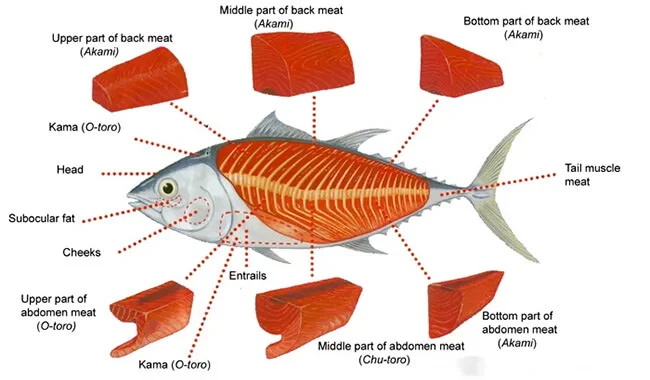
The Atlantic bluefin tuna is highly sought after for Japanese raw fish dishes and is consumed mainly in Japan, accounting for approximately 80% of the caught Atlantic and Pacific bluefin tuna. In Japan, the delicacy of choice is bluefin tuna sashimi. For instance, in 2008, a catch of Atlantic bluefin fetched a price of US$247,000 at Tokyo's Tsukiji fish market. However, this price is lower than the highest prices paid for Pacific Bluefin. Historically, the late 1970s and 1980s saw the peak of these high prices.
The tradition of eating tuna sushi in Japan dates back to the 1840s when a significant catch arrived in Edo (now Tokyo) during one season. A chef decided to marinate a few pieces in soy sauce and serve them as nigiri sushi. These fish were nicknamed "Shibi", meaning "four days", because chefs would bury them for four days to reduce their intense flavour.
Initially, fish with red flesh were considered inferior and undesirable in Japan, as white fish were preferred. Red-fleshed fish would spoil quickly and emit a noticeable odour, which made them unpopular among the Japanese aristocracy and the citizens of Edo before refrigeration was available. However, by the 1930s, tuna sushi had become a familiar and widely enjoyed dish in Japan.
Kanji: 本鮪
Kana: ほんマグロ
Romaji: honmaguro
The Atlantic bluefin tuna is highly sought after for Japanese raw fish dishes and is consumed mainly in Japan, accounting for approximately 80% of the caught Atlantic and Pacific bluefin tuna. In Japan, the delicacy of choice is bluefin tuna sashimi. For instance, in 2008, a catch of Atlantic bluefin fetched a price of US$247,000 at Tokyo's Tsukiji fish market. However, this price is lower than the highest prices paid for Pacific Bluefin. Historically, the late 1970s and 1980s saw the peak of these high prices.
The tradition of eating tuna sushi in Japan dates back to the 1840s when a significant catch arrived in Edo (now Tokyo) during one season. A chef decided to marinate a few pieces in soy sauce and serve them as nigiri sushi. These fish were nicknamed "Shibi", meaning "four days", because chefs would bury them for four days to reduce their intense flavour.
Initially, fish with red flesh were considered inferior and undesirable in Japan, as white fish were preferred. Red-fleshed fish would spoil quickly and emit a noticeable odour, which made them unpopular among the Japanese aristocracy and the citizens of Edo before refrigeration was available. However, by the 1930s, tuna sushi had become a familiar and widely enjoyed dish in Japan.
Kanji: 本鮪
Kana: ほんマグロ
Romaji: honmaguro