chldudghks0517
Black Rooster
- 21 Oct 2012
- 142
- 13
Hi, all.
I learned about volitional forms of verbs today from my GENKI II book. I understood it as a less formal way to suggest or request something - a more casual way of saying "ましょう". I've also found out that it is often used when speaking with close friends. Please correct me if I am wrong or add some information if you think I'm missing out something.
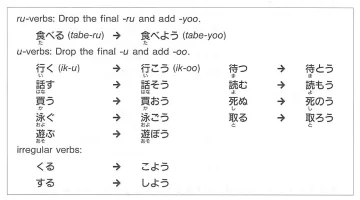
That is chart shown in the GENKI II book that I'm using. I've some up with some sentences and I'm hoping you could comment on it. (what's wrong, what sounds more natural, wrong spelling and etc.)
1. 明日、AKB48の公演があるから、授業をサボって見に行こうか。
Context: I'm asking my friend to cut classes with me to watch an AKB48 concert tomorrow. By the way, AKB48 is a famous girl idol group in Japan along with Morning Musume. I guess some people in JREF, who are living in Japan, are familiar with them.
2. おまえエッチなもの好きだろう? 昨日、'ヨスガノソラ'というエッチのアニメを見たんだ。これ、本当にすごいよ。彼女の妹とあの妹の男のお兄さん間のラブスオリーなの。ちょっと変だけど、今晩一緒に見ようね。Later, することが別にないし、一人で見るのはつまらないし。
Context: My friend is kind of perverted. And yesterday, I watched an ecchi anime called "Yosuga no Sora". I tell him that this anime is the perfect one for him. It's about the forbidden love between a sister and her older brother. Then I go saying that this is kind of weird (because its a twincest) but ask him if he would like to watch it with me tonight because I don't have any plans for tonight and watching it alone is boring.
By the way, the anime is real and I suggest you don't watch it (or even search for it) if you are disgusted by incest type of animes. Trust me, I was utterly shocked.
3. 私たちには希望が全然ないよ。この大きいなかりを返す方法はない。終わりだ。一緒に死のうよ。
Context: There is no hope for us, not even the slightest. There is no way to settle this huge debt. This is the end. Let's die together. (Yeah I know, this is kind of extreme.)
By the way, does "死のう" in the sentence make sense?
4. いい天気だね~~。雑誌からいいベケーションスポットを見たんだ。予定がなければ、この場所のプールに泳ごう。
Context: I saw a good vacation spot in a magazine. Then I ask my friends to swim with me in the pool of this vacation spot if they don't have other plans.
You don't have to comment on all of them. That would be asking for too much.
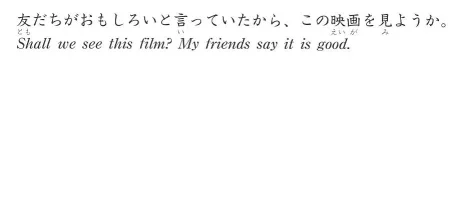
And I have another concern regarding this sentence construction.
友たちが面白いといっていたから、この映画を見ようよ。
Can't that sentence be rewritten as
友たちが面白いといったから、この映画を見ようよ。
?
Would that change the original meaning?
Thank you for answering in advance. I appreciate all your replies.
I learned about volitional forms of verbs today from my GENKI II book. I understood it as a less formal way to suggest or request something - a more casual way of saying "ましょう". I've also found out that it is often used when speaking with close friends. Please correct me if I am wrong or add some information if you think I'm missing out something.
That is chart shown in the GENKI II book that I'm using. I've some up with some sentences and I'm hoping you could comment on it. (what's wrong, what sounds more natural, wrong spelling and etc.)
1. 明日、AKB48の公演があるから、授業をサボって見に行こうか。
Context: I'm asking my friend to cut classes with me to watch an AKB48 concert tomorrow. By the way, AKB48 is a famous girl idol group in Japan along with Morning Musume. I guess some people in JREF, who are living in Japan, are familiar with them.
2. おまえエッチなもの好きだろう? 昨日、'ヨスガノソラ'というエッチのアニメを見たんだ。これ、本当にすごいよ。彼女の妹とあの妹の男のお兄さん間のラブスオリーなの。ちょっと変だけど、今晩一緒に見ようね。Later, することが別にないし、一人で見るのはつまらないし。
Context: My friend is kind of perverted. And yesterday, I watched an ecchi anime called "Yosuga no Sora". I tell him that this anime is the perfect one for him. It's about the forbidden love between a sister and her older brother. Then I go saying that this is kind of weird (because its a twincest) but ask him if he would like to watch it with me tonight because I don't have any plans for tonight and watching it alone is boring.
By the way, the anime is real and I suggest you don't watch it (or even search for it) if you are disgusted by incest type of animes. Trust me, I was utterly shocked.
3. 私たちには希望が全然ないよ。この大きいなかりを返す方法はない。終わりだ。一緒に死のうよ。
Context: There is no hope for us, not even the slightest. There is no way to settle this huge debt. This is the end. Let's die together. (Yeah I know, this is kind of extreme.)
By the way, does "死のう" in the sentence make sense?
4. いい天気だね~~。雑誌からいいベケーションスポットを見たんだ。予定がなければ、この場所のプールに泳ごう。
Context: I saw a good vacation spot in a magazine. Then I ask my friends to swim with me in the pool of this vacation spot if they don't have other plans.
You don't have to comment on all of them. That would be asking for too much.
And I have another concern regarding this sentence construction.
友たちが面白いといっていたから、この映画を見ようよ。
Can't that sentence be rewritten as
友たちが面白いといったから、この映画を見ようよ。
?
Would that change the original meaning?
Thank you for answering in advance. I appreciate all your replies.