First, I am actually Chinese living in California. Based on your replay, I would assume you are from a western country so I can understand why you think it is unfair to compare Imperial Japan with Nazi. It is just the same reason so many people in Eastern Asia actually warships Nazi Germany for its power and mourn the fallen of 3rd Reich. Ideologically Nazism is notorious for genocide, but few (in the west) known that Imperial Japanese considered all other 'inferior' Asians to be lowly asserts for Japan to form its Asian Empire, which is almost identical to Nazi ideology. I am not going to expand on what Japanese did to us. But if you are interested in the issue you can always start with the name John Rabe, the German who witnessed the massacre in Nanking. In short, the only difference I see in Imperial Japan is that they did not dedicate their atrocities to a specific ethic group but to all under their occupation.
I know all about what Japan did in China and in Asia in general. The thing is, I think it was absolutely horrible, and crimes against humanity, but I still think it's not helpful to liken Japanese to Nazis, because what the Nazis did was make a plan for genocide, while the Japanese were not trying to exterminate any people. They did do appalling things, in Nanking, in China, in Indonesia, in Korea. I think the historical record in the world is confident of this fact, even if there are deniers in Japan still.
I've never heard of anywhere worshipping Nazi Germany in Asia. I've seen them liking the fashion a few times in my years here, but worshipping them and mourning for them? I think that would have to be .1% or less. Nothing to hold up as an example.
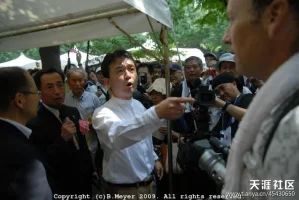
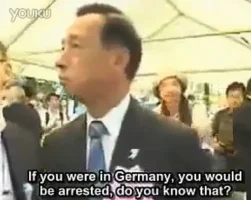
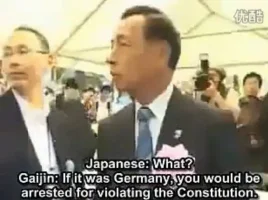
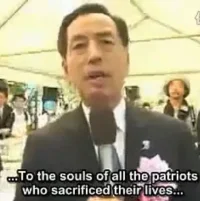
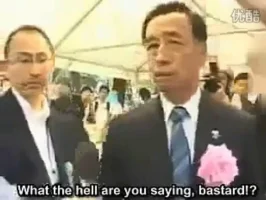
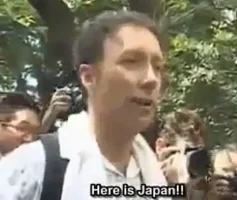
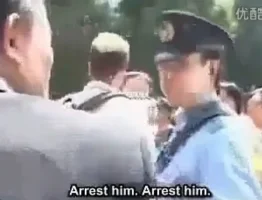
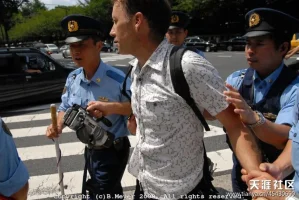
Back to the issue itself. I did a little study so the guy challenged in the video was Toshio Tamogami, a definite right-wing who publicly stated Imperial Japan was not a invader in WWII. Apparently that is why the Canadian asked the question in the first place. All issues aside, I do not see how the Canadian deserved to be take into custody in a democratic country by any means. He did not interrupt any ceremony, as you can see Toshio was obviously taking an interview. He did not use any offensive language let alone physical assaults. He even asked for attention politely and waited until Toshio turn to him before throwing out the question instead of "ran in to ceremony and yelling".
Most countries in the world would take a person into custody if the police perceived them as harassing a politician or military person. Especially if it was a foreigner. It would happen in America, Canada, pretty much any country I have knowledge of. Maybe there is a country you can travel to and get in the face of a prominent person, linking them to nazis, and the police will let you, but I don't see it. That is the state of democracy. You have some freedoms, but police can take you in for causing a disturbance. They often won't press charges
these days, but this is not a new thing at all.
Furthermore, how did Toshio, as a politician and former general, react to a tough, may be even embarrassing question? I would imagine him reply things like "But this is Japan" or "We are not Nazi" or simply ignore and leave. However, he let his retinues raged and followed the guy, eventually got the guy took into custody. Well, he is probably categorized as a Uyoku so it does not really matter. What puzzled me is the custody part. With all possible embarrassment, I would imagine this kind of thing happen in my home country, China, or under any other authoritarian government. But Japan? What makes the police decide to side with the Uyokus and eventually humiliate the Canadian by making him write the letter of apology? Did local police department simply send right-wing policemen to secure such sensitive ceremony? To me, there is only two possible answers:
The police sided with the citizen who was targeted by this guy, and not with the foreigner who started the whole thing. Why would he not deal with the foreign guy trying to press him with uncomfortable questions? I think he did as most people would in that situation.
This is not any excuse for whatever Tamogami thinks or does, I don't know. But there is no doubt why the police of a country side with their own citizen in a disturbance with a foreigner.
A. Deep in heart, Japan actually has an authoritarian government.
B. The ideology of Japanese government more or less side with the Uyokus.
A: Sort of. But all (big) countries do when you go against them. They resist. That is the nature of power. America created "free speech zones" which prevented free speech, for much of the Iraq War. That was an authoritarian move. Canada sent police with badge numbers and faces covered to deal with protestors. That was authoritarian. I think those are terrible actions. And they aren't supported by many or most, but making change through voting requires time and a well-informed population. Japan is not going to get upset over police taking a Canadian into custody
for two hours when their economy is hurting, the population is facing an ageing crisis, the baseball tournament is on, etc etc. You are expecting too much from the Japanese government. It's really unrealistic.
B: No. There are people who are hard right, who are naturally drawn to politics, and there is a debate within the government, but it is foolish to claim the government is on the side of one thing or the other. You may as well say the American government is more or less Republican. I don't think the Uyoku influence on government is more than 20%. Most of the government is more concerned with the economy than it is with history or the military.
And speak of Yasukuni Shrine itself. I do not think visiting the shrine makes you a right-winger or Imperial Japan supporter. I respect tradition and holy sites of all nations and ethical groups. However, I do wonder that, if Uyokus are "embarrassment of rest of the country", why those A-class war criminals, the spiritual idols of Uyokus, got to resides in Japanese holy site so many years, even after the issue caused so much trouble?
I would say, it is because the statement of Uyoku is just a diplomatic statement trying to make the rest of the world comfortable.
Why does the US have the Vietnam Memorial? How did one of the top US military war criminals, Henry Kissenger, get a Nobel Peace Prize?
Because, "For your country," has a lot of weight. Chiang Kai-Shek was a brutal tyrant for China, while a national hero in Taiwan. But he was all the same guy. Both sides focus on a different aspect of him.
I understand your frustration with the actions of some Japanese, but you would be well off to come and live in Japan for a few years, make close friendships with Japanese, before thinking that there is some pride in their war crimes. They just love their country, as most healthy people do.