Can anyone translate this please?

I'll give it a shot, but we should wait for a native Chinese speaker to check this.

"Hello, Benedukt!
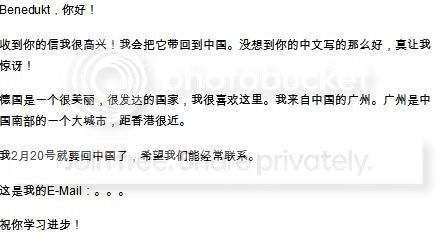
I'm very happy to have received you letter! I will take this back with me to China. (???) (Something about not thinking your Chinese writing is good, but I'm not sure what he's saying there) Germany is a beautiful and friendly country, and I really like it (here). I come from Guangdong (Canton), China. Guangdong is a large city (region?) in southern China, and it's very close to Hong Kong. I have to go back to China on Feb. 20th, but I hope we can stay in touch. This is my e-mail: (blurred out).
Let's see your studies advance! (???)"

Alright, so there are some spots I'm really not sure about in there, but I think that's the basic idea of the letter. I'd like to know where I went wrong here, so to our native Chinese speakers 'æ'ë'µ'­'¨Šè'¢'µ'Ü'· (sorry, I don't know how I would say that in Chinese :blush:)!
 
thank u a lot. now i have at least an idea what he says ... *happy*
 
Hello, Benedukt!
I'm very happy to have received you letter and I will take this back with me to China.I am very surprised that you could write Chinese so well.
Germany is a beautiful and friendly country, and I really like here. I come from Guangdong (Canton), China. Guangdong is a large city in southern China, and it's very close to Hong Kong.
I have to go back to China on Feb. 20th, but I hope we can stay in touch. This is my e-mail: (blurred out).
Hope you will make progress in your studies.
 
i see i have to learn a lot... i've learned 2 lessons yet...
 
ookubo said:
Glenn,
your Chinese is subarashii ,to be honest.
:blush::bluush:
Really, it's not all that good. This was pretty basic and I'm still embarassed for my lack of knowledge.
I did learn something new today, though. Apparetnly when you use —¹ with stative verbs (or adjectives) you don't use œk. For example, ‰äœk—Ý is "I am tired," but you wouldn't say ‰äœk—Ý—¹ for "I have become tired"; instead you would say ‰ä—Ý—¹ ("æ'ê'Ä'«'½j. I guess that's only for the "sentence-final —¹," though, and perhaps if you're using the aspect marker —¹ it's a little different. Anyway, that's just one more small piece of the puzzle that became clear to me today. Anyway, thanks for the compliment! "¹‰êŽÓŽÓ (was that even close?)!
 
Last edited:
Glenn said:
:blush::bluush:
Really, it's not all that good. This was pretty basic and I'm still embarassed for my lack of knowledge.
I did learn something new today, though. Apparetnly when you use —¹ with stative verbs (or adjectives) you don't use œk. For example, ‰äœk—Ý is "I am tired," but you wouldn't say ‰äœk—Ý—¹ for "I have become tired"; instead you would say ‰ä—Ý—¹ ("æ'ê'Ä'«'½j. I guess that's only for the "sentence-final —¹," though, and perhaps if you're using the aspect marker —¹ it's a little different. Anyway, that's just one more small piece of the puzzle that became clear to me today. Anyway, thanks for the compiment! "¹‰êŽÓŽÓ (was that even close?)!

Hmmm...Now I think that I am too weak in grammar.......

In my opinion,the meaning of ‰ä—Ý—¹ is I am tired,and ‰äœk—Ý is to show that you are VERY tired.We always use ‰ä›ß经œk—Ý—¹ to express that I am already too tired.....Anyway,hope you can understand.I found my English is poor....GOD
 
Haha, well, that just goes to show how little I know about Mandarin. I wouldn't have thought to use ›ßãS.

Just to be sure, though, the original sentence was Œ»ÝÎ–û‹M—¹ (I think). In English it was "gas has become expensive." So maybe by ignoring the presence of Œ»Ý I hurt myself, but again my knowledge is pretty weak. Anyway, the example that I gave was my guess as to how to say that in Mandarin, and it wasn't the example that was given me earlier by someone who knows better.

Aside from that, I thought that ‰äœk—Ý would just mean "I'm tired," because the œk is necessary to make the sentence sound complete and doesn't necessarily mean "very" in this instance. To further clarify, would you say that ‰ä›ßãSœk—Ý—¹ is like 'à'¤"æ'ê'Ä'é?
 
it's like watching dragons the size of buildings being modest about their destructive power to each other.

"nono, really. you could easily tear down that building, while my tearing powers are still only at a first graders level!"
 
Thanks for the comparison with a dragon, but really, as the thread will show, I know next to nothing about Manarin. Trust me, I'm not just being polite. There's at least one person who will definitely agree with me here.
 
Most of you have the bulk of the letter right in a rough translation, however this is the complete translation.

Chinese to English translation:

"Hi Benedukt!

I'm very happy to receive your letter! I will bring it back to China. I didn't think that you can write Chinese that well, which amazed me!

Germany is a very beautiful and developed country. I really like it there. I come from Guangzhou, China. Guangzhou is a large city in Southern China, which is near Hong Kong.

I will be returning to China on February 20th. Hope we can always keep in touch.

This is my E-mail: ...

Wish you progress in your studies!"


Chinese original:

Text.jpg


Hope this clears things up.

EDIT: Uploaded an image instead as the Chinese characters weren't displaying properly.
 
Last edited:
Whoops... Guangzhou, not Guangdong (廣東). Heh, that's quite a difference. Now the "city" part makes more sense.
 
qoute: 我2月20号。。。

why does he use "号" and not "日"??

ps: i've just learnd to lessons of chinese.
 
Glenn said:
† is the usual way of saying it; "ú is more formal.

Well,if you use "‰ä2ŒŽ20"ú...",that is OK,but "‰ä2ŒŽ20†..." is better.

HOWEVER:
"When will you be returning to China?"---->"你™{†‰ñ'†'?",in this sentence you cannot say "你™{"ú‰ñ'†'?"
 
ookubo said:
Well,if you use "‰ä2ŒŽ20"ú...",that is OK,but "‰ä2ŒŽ20†..." is better.
HOWEVER:
"When will you be returning to China?"---->"你™{†‰ñ'†'?",in this sentence you cannot say "你™{"ú‰ñ'†'?"
Yes you can; it's just that the former is much more common.
 
たとえば,
"今天是2月26号星期日"--->ただしい
"今天是2月26日星期日"--->ちょっと変
 
Like I said, '日' is just less used in general, particularly in speech, but is perfectly acceptable. So, "今天是2月26日星期日" is standard - there is nothing odd about it in any way. In fact, when it comes to the written language, '日' is more preferred as it is more literary and formal.

The two variants are very similar to how the word 'Sunday' is used: it could be either '星期天' or '星期日'. The latter is also used more often in writing.
 
Supervin said:
Like I said, '"ú' is just less used in general, particularly in speech, but is perfectly acceptable. So, "¡"V¥2ŒŽ26"ú¯Šú"ú" is standard - there is nothing odd about it in any way. In fact, when it comes to the written language, '"ú' is more preferred as it is more literary and formal.
The two variants are very similar to how the word 'Sunday' is used: it could be either '¯Šú"V' or '¯Šú"ú'. The latter is also used more often in writing.

Sorry,but I think "—ç`"V" is more often used in speech other than "¯Šú"V"

Anyway,I assumed you able to speak MADARIN
 
ookubo said:
Sorry,but I think "—ç`"V" is more often used in speech other than "¯Šú"V"
Anyway,I assumed you able to speak MADARIN
Look, I'm a native speaker of English, have a mother tongue in Cantonese and have reached native speaker in Mandarin after a number of years. I also have friends in China who grew up there. So I do know what I'm talking about.

On the other hand, you don't know what you're talking about.

Mandarin speakers use '¯Šú"V' the most. They also use '¯Šú"ú', '—ç`"V' and '—ç`"ú'.

Cantonese speakers use only '¯Šú"ú' and '—ç`"ú'.

If you carry on with this attitude, I won't waste my time clarifying things for your sake.
 
Last edited:
Supervin said:
Look, I'm a native speaker of English, have a mother tongue in Cantonese and have reached native speaker in Mandarin after a number of years. I also have friends in China who grew up there. So I do know what I'm talking about.
On the other hand, you don't know what you're talking about.
Mandarin speakers use '¯Šú"V' the most. They also use '¯Šú"ú', '—ç`"V' and '—ç`"ú'.
Cantonese speakers use only '¯Šú"ú' and '—ç`"ú'.
If you carry on with this attitude, I won't waste my time clarifying things for your sake.
I think —ç`"V is used most frequently by Mandarin speakers of Taiwan. In countries like Malaysia and Singapore the Mandarin speakers there usually use ¯Šú"V the most. I am not sure about the mainland.
Oh by the way you mentioned that Mona Lisa bridal is expensive due to advertising do you know any value for money wedding photography shop in HK?:clueless:
 
Minty said:
I think —ç`"V is used most frequently by Mandarin speakers of Taiwan.

In countries like Malaysia and Singapore the Mandarin speakers there usually use ¯Šú"V the most. I am not sure about the mainland.
Yeah, it's true that Taiwanese Mandarin speakers use '—ç`"V' quite a bit, but I also hear a lot of '¯Šú"V' there as well like in China, Malaysia and Singapore.

Minty said:
Oh by the way you mentioned that Mona Lisa bridal is expensive due to advertising do you know any value for money wedding photography shop in HK?:clueless:
I'm afraid I don't, specifically, and Mona Lisa seems to be the only place I've heard of in Hong Kong. :p

But, there is a whole area - about two streets full - where many wedding shops for photography and fashion are based, so you can shop around and compare before deciding. The place is located in between two districts (i.e. it stretches over both): Tsim Sha Tsui and Jordan.

If you want to obtain specific info beforehand, you could either phone or email the Hong Kong Tourism Board about it:

http://www.discoverhongkong.com/eng/misc/mi_contact_us.jhtml

Otherwise, you could also get info when you arrive at the Hong Kong International Airport, from the Tourism Information Desk.

Hope this helps.
 
He has very nice Chinese handwriting! :cool: Anyways, yeah, the others got to translate it before i could! :( I would have! lol
 
Back
Top Bottom