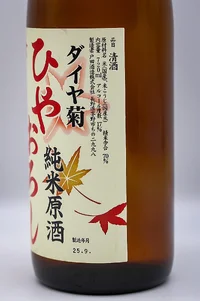
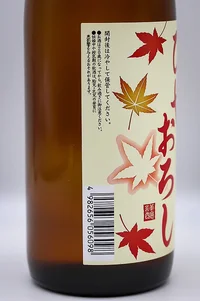
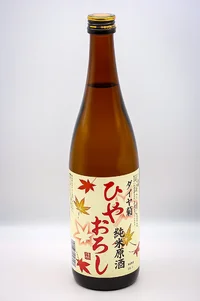
Sake specs
- Prefecture
- Nagano (長野)
- Rice type
- Domestic rice (国産米)
- Polishing rate (semaibuai)
- 70%
- Alcohol content
- 17%
- SMV
- +3.4
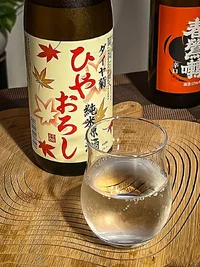
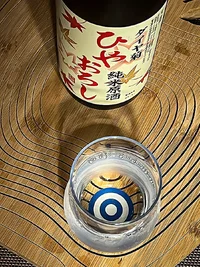
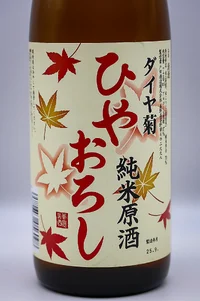
Toda Daiyakiku Junmai Ginjō Hiyaoroshi (ダイヤ菊 純米原酒 ひやおろし) is made with rice grown in Nagano that offers a full-bodied flavour with a satisfying richness and gentle sweetness that come naturally from the rice. Served at room temperature or gently warmed, it pairs exceptionally well with hot pot dishes, making it an ideal autumn drink. It also goes nicely with grilled salted Pacific saury (sanma no shioyaki).
What is "hiyaoroshi"?
In the Edo period , freshly pressed shinshu (new sake) brewed in winter was pasteurised in early spring to prevent spoilage, then stored in large barrels over the summer. When the temperature of the storehouse and the outside air became roughly the same in early autumn, the sake was shipped out "hiya" (without a second pasteurisation) straight from the storage casks — hence the name hiyaoroshi. It came to be prized as a seasonal sake of autumn.Toda Shuzō's hiyaoroshi follows this same tradition. The sake is brewed in winter through early spring, pasteurised once around springtime, then slowly aged through the summer in the brewery's cool storehouses (kept around 20°C even in midsummer) before being released at this time of year.




About the brewery
- Brewery
- Toda Brewery
- Name in Japanese
- 戸田酒造
- Address
- 2998 Chino, Chino City, Nagano Prefecture, 391-0001
- Phone
- 0266-72-2118
- Website
戸田酒造株式会社 =銘酒「ダイヤ菊」醸造元=
蓼科山随一の酒蔵として、甘・辛・酸・苦・渋の五味が融和した、しっかりとした味わいの酒造りに徹してきました。巨匠小津安二郎監督もこよなく愛したダイヤ菊。これは最高の宝石「ダイヤモンド」と日本の名花「菊」を組合せ、最高の酒造りを目指して命名されました。www.shopdaiya.jp
- Online store

Daiya Kiku's origins trace to 1717 in Nagano as Sanraku (三楽). In 1914, the modern iteration launched as Daiya Kiku and Daiya Tsuru (ダイヤ鶴)—names combining "diamond" (ダイヤモンド) with "chrysanthemum" (菊) to signal the pursuit of quality. Both brands succeeded in the Tokyo market through the 1920s-30s. In 1951, Toda Shuhan acquired and restructured the operation under the corporate name Daiya Kiku Sake Brewery (ダイヤ菊酒造株式会社).
Daiya Kiku earned cultural prominence in the 1950s-1960s through an unlikely champion: film director Ozu Yasujirō (小津安二郎). While writing screenplays at his vacation residence in Yatsugatake, Ozu became devoted to Daiya Kiku. References permeate his published journal Yatsugatake Diary (蓼科日記), documenting the sake he drank during his stays. Through the 1970s, the brewery ran aggressive newspaper advertising claiming "one in every one hundred bottles sold in Tokyo is Daiya Kiku"—marketing that traded on both regional identity and Ozu's implicit endorsement.
The current flagship offering, Daiya Kiku Josen Karakuchi (ダイヤ菊 上撰辛口), is a dry sake made from Nagano rice polished to 70%, with a sake meter value of +8 and 15% alcohol. The profile emphasises body and cut—versatile enough to serve warm or chilled. This versatility reflects the brewery's original philosophy: sake that adapts to meals and seasons rather than demanding singular conditions.
The brewery maintains deep roots in Nagano's Suwa region, where mountain spring water and the local terroir shape its expression. For sake drinkers, Daiya Kiku represents an older model of regional brewing—not experimental or premium-tier, but specifically calibrated for food compatibility and sustained drinkability. Through Toda Shuhan's distribution network across Yamanashi, these bottles reach consumers in their prefecture of adoption rather than as imported curiosities.