


- 14 Mar 2002
- 21,050
- 18,904
The main keep of Hiroshima Castle, in Naka Ward in this western Japan city, was closed on 22 March. It had stood for nearly 70 years since being rebuilt in reinforced concrete after collapsing in the atomic bombing, and had long been a familiar presence for residents.
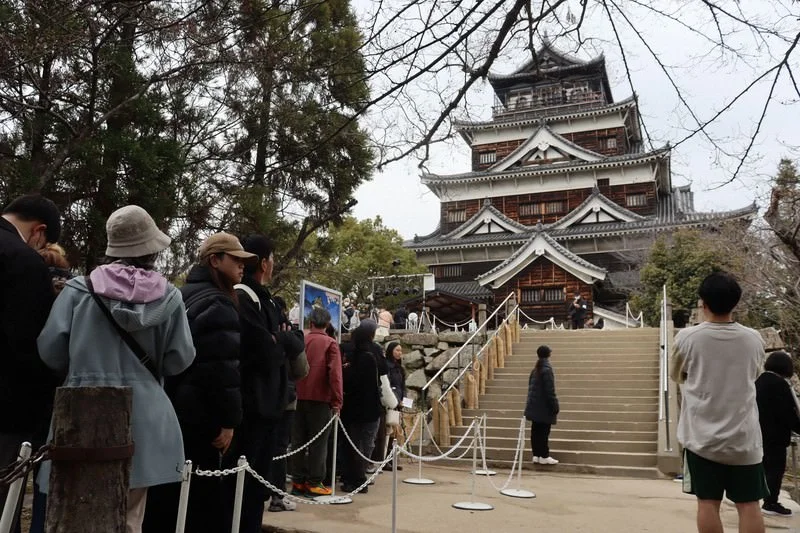
City officials said the closure was due to the structure's age and concerns over its earthquake resistance. The keep has now ended its role as a museum for local historical materials. An expert panel set up by the Hiroshima municipal government has indicated that demolishing the current structure and rebuilding it in wood would be the most viable option, and discussions are continuing in that direction.
In March, people gathered in large numbers to see the keep before it shut. Lines formed most days, with both residents and tourists turning up. In the final three days, which fell during a holiday period, numbered tickets were handed out, and entry was capped at 4,000 visitors per day. It was busy and, at times, a bit difficult to manage.
The building itself will not be taken down straight away, so the exterior remains visible for now. Materials that had been displayed inside are to be moved to a new facility planned for the Sannomaru area within the castle grounds.
It's expected to take five years to gather additional materials needed for accurate reconstruction and to study demolition methods that will not damage the stone walls. After that, drafting of basic plans and detailed designs will proceed. At a minimum, demolition and reconstruction are expected to take nine years, with completion of the new keep projected in 2049, 23 years from now. The estimated cost currently stands at about 19.5 billion yen (about $122 million), making the large project budget another major issue.

 mainichi.jp
City officials said the closure was due to the structure's age and concerns over its earthquake resistance. The keep has now ended its role as a museum for local historical materials. An expert panel set up by the Hiroshima municipal government has indicated that demolishing the current structure and rebuilding it in wood would be the most viable option, and discussions are continuing in that direction.
In March, people gathered in large numbers to see the keep before it shut. Lines formed most days, with both residents and tourists turning up. In the final three days, which fell during a holiday period, numbered tickets were handed out, and entry was capped at 4,000 visitors per day. It was busy and, at times, a bit difficult to manage.
The building itself will not be taken down straight away, so the exterior remains visible for now. Materials that had been displayed inside are to be moved to a new facility planned for the Sannomaru area within the castle grounds.
Hiroshima Castle has a history spanning over 430 years. It is a flatland castle built on a delta at the mouth of the Ota River by Mori Terumoto, a warlord in Japan's Sengoku (Warring States) period (1467 to the late 16th century), and is believed to have been completed in the 1590s. From the Edo period (1603-1867) onward, the Asano family served as lords of the castle for 12 generations. After the Meiji Restoration of 1868, military facilities, including a divisional headquarters and training grounds, were established within the castle, making it the core of what came to be known as "the military city of Hiroshima." On 6 August 1945, the atomic bomb dropped by the United States during World War II destroyed the castle keep, located 980 meters north of the hypocenter.
It's expected to take five years to gather additional materials needed for accurate reconstruction and to study demolition methods that will not damage the stone walls. After that, drafting of basic plans and detailed designs will proceed. At a minimum, demolition and reconstruction are expected to take nine years, with completion of the new keep projected in 2049, 23 years from now. The estimated cost currently stands at about 19.5 billion yen (about $122 million), making the large project budget another major issue.
Hiroshima Castle keep closed over safety concerns, wooden revival proposed - The Mainichi
HIROSHIMA -- The main keep of Hiroshima Castle in this western Japan city's Naka Ward was closed on March 22. The structure had been beloved by reside


