


- 14 Mar 2002
- 21,050
- 18,904
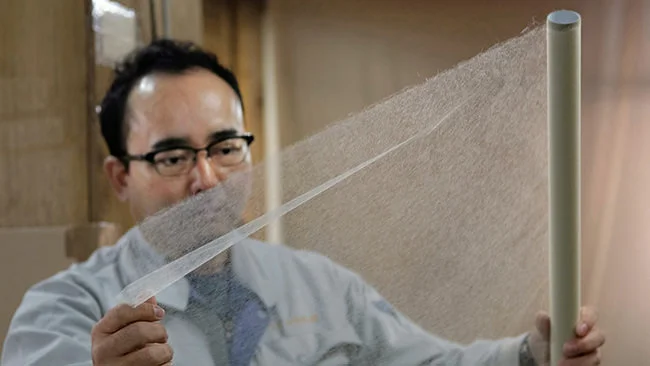
Hidaka, a picturesque village nestled along the pristine Niyodo River in Japan, is home to Hidakawashi Co. This small manufacturer has achieved global acclaim for producing the world's thinnest Japanese paper. This remarkable paper, measuring a mere 0.02 millimetres thick and weighing only 1.6 grams per square meter, has captivated prestigious institutions worldwide, including the British Museum and the Louvre, which utilize it to restore cultural artefacts.
Located on the outskirts of Hidaka, a tranquil village surrounded by streams and fields, Hidakawashi employs just ten individuals. Within its facility, a specialized paper machine meticulously draws out the ultrathin paper into continuous rolls, showcasing a remarkable blend of traditional craftsmanship and modern technology.
Tengujō, also known as tenguchō paper (典具帖紙 tenguchōshi), is a highly specialized type of Japanese paper renowned for its exceptional thinness. Crafted from kōzo fibres, a kind of mulberry tree, this nearly transparent paper has been produced by Hidaka Washi in Kōchi Prefecture, Japan, since 1949. The manufacturing process utilizes kōzo fibres, alkaline water, and neri, a viscous liquid derived from the Tororo-aoi plant.
Given its remarkable thinness and delicate nature, Tengujō paper finds significant application in archival conservation, where it's used to preserve delicate artefacts carefully. Beyond its archival uses, Tengujo paper has also found innovative applications in lighting design, where its translucent properties create unique and captivating visual effects.

 mainichi.jp

Located on the outskirts of Hidaka, a tranquil village surrounded by streams and fields, Hidakawashi employs just ten individuals. Within its facility, a specialized paper machine meticulously draws out the ultrathin paper into continuous rolls, showcasing a remarkable blend of traditional craftsmanship and modern technology.
Tengujō, also known as tenguchō paper (典具帖紙 tenguchōshi), is a highly specialized type of Japanese paper renowned for its exceptional thinness. Crafted from kōzo fibres, a kind of mulberry tree, this nearly transparent paper has been produced by Hidaka Washi in Kōchi Prefecture, Japan, since 1949. The manufacturing process utilizes kōzo fibres, alkaline water, and neri, a viscous liquid derived from the Tororo-aoi plant.
Given its remarkable thinness and delicate nature, Tengujō paper finds significant application in archival conservation, where it's used to preserve delicate artefacts carefully. Beyond its archival uses, Tengujo paper has also found innovative applications in lighting design, where its translucent properties create unique and captivating visual effects.
The paper is durable and so thin that even detailed characters remain legible when layered over documents. It also resists yellowing and discolouration. Though order quantities are small, the company responds with custom-made products, and its paper has earned the high trust of preservation and restoration sites worldwide, as it doesn't damage the original texture of cultural assets or artworks. Now, 40% of the firm's sales are for cultural property restoration, with 90% overseas sales. Tosa washi paper has been produced for over a thousand years, primarily in the Kochi Prefecture town of Ino. It is considered one of Japan's three major washi papers, alongside Echizen washi from Fukui Prefecture and Mino washi from Gifu Prefecture. Tosa Tengujo paper, which emerged in the Meiji era (1868-1912), is produced by hand and known for its thin sheets with a 0.03 to 0.05 mm thickness. Building on this technology, Hidakawashi achieved mass production of the world's thinnest Japanese paper using machines, and the company's strength is keeping costs down to supply products at affordable prices. In addition to the machine papermaking process, artisans painstakingly prepare the raw materials by hand.
Why the world's thinnest Japanese paper is drawing customers from around the world - The Mainichi
HIDAKA, Kochi -- In this village by the pristine waters of the Niyodo River, a small manufacturer of Japanese paper has won global recognition by succ
Hidakawashi Co., Ltd.
Producer of the world's thinnest Japanese paper


