Crime Fake monks scamming unsuspecting tourists

thomas

Unswerving cyclist
Admin
Joined
14 Mar 2002
Messages
21,050
Reaction score
18,903
According to a recent report by FNN, the surging number of foreign tourists attracts a unique set of scammers: scammers posing as monks loitering about Tokyo temples and shrines, such as Ueno Toshogu Shrine in Ueno Park, selling unsuspecting tourists cheap amulets they charge up to 10,000 JPY for.
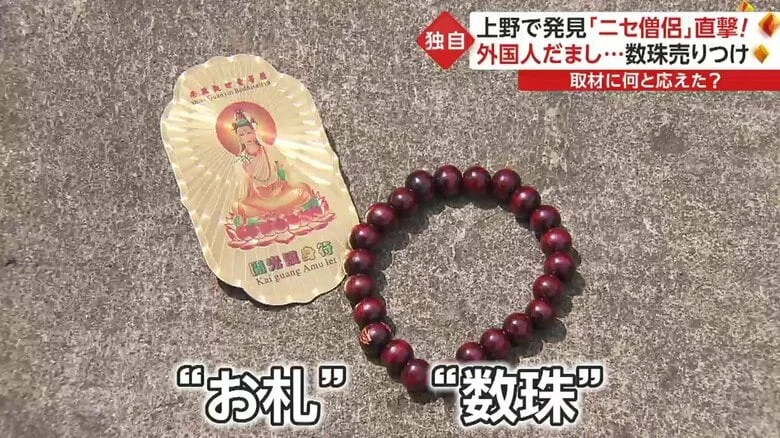

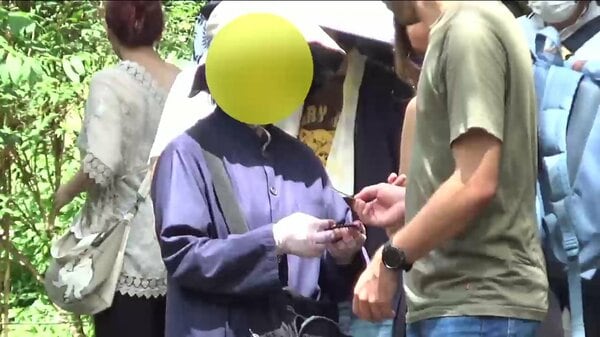
One recent news reporter witnessed a tourist being scammed out of their money at the shrine, as the monk, dressed in an orange robe, approached them and gave them the amulet. Thinking it to be a gift, the tourist thanked the monk, who then insisted they needed to pay for it, with the price being 10,000 yen. After the transaction had been made, the reporter approached the tourist to ask them what had just happened. The tourist showed the reporter the amulet and explained that he'd bought it from the monk. The reporter then informed them that it was a scam, and the tourist appeared stunned, having fully believed the monk was associated with the shrine. According to the news report, there wasn't just one fake monk at the shrine when they visited, but several, with two women in navy blue robes also approaching tourists as well. Upon speaking to one of the women, she told the reporter she was from Thailand, but refused to answer any more questions, instead heading to the public restroom at Ueno Station where she later emerged wearing civilian clothes.


img_7146010d8a3dada4446a9b7cdd0e1d6d494194.webp

Tourists are charged up to 10,000 JPY for amulets.

More photos in the FNN article linked below.


I've seen this same thing in Boston. They give you a "gift" and then expect you to "donate" money to them. My wife and I got a gift when we were out by the wharf once. They were mad when we donated nothing and it became clear to them that we had no intention to give them anything in return. They took their gift back. Fine by me.

The only real monks I've seen Japan who ask for money are the ones you occasionally see at the train station. They just stand there with their bowl in front of them. They don't approach you or call to you or even say a word. They just stand there. And I've never seen them wear orange in Japan. And they were without exception men.
 
And I've never seen them wear orange in Japan. And they were without exception men.

The article hinted that the individuals observed by the FNN reporters were from Thailand, where Buddhist monks wear orange garments. They also said the "monks" seen in 2016/17 were Chinese nationals. I was surprised that some tourists paid 10,000 yen for the amulets. 😳
 
Isn't orange the color for Buddhism of the Small Vehicle? I'm quite certain that the Buddhism that made its way to Japan was all of the Large Vehicle.
 
Isn't orange the color for Buddhism of the Small Vehicle? I'm quite certain that the Buddhism that made its way to Japan was all of the Large Vehicle.
You're correct! In Buddhism, orange is indeed associated with the Small Vehicle, also known as Theravada Buddhism. However, when it comes to Japan, the Buddhism that made its way there is primarily of the Large Vehicle, which is known as Mahayana Buddhism1. Let me provide you with more details about these two branches:
  1. Theravada Buddhism (Small Vehicle):
    • Theravada Buddhism is one of the three main existing branches of Buddhism, alongside Mahayana and Vajrayana.
    • It originated in ancient India and is often associated with the early teachings of the Buddha.
    • Theravada practitioners believe that adhering to a specific path can lead to individual salvation.
    • The color associated with Theravada Buddhism is orange2.
    • While it has followers in various countries, it is particularly prevalent in Sri Lanka, Myanmar (Burma), Thailand, Cambodia, and Laos.
  2. Mahayana Buddhism (Large Vehicle):
    • Mahayana Buddhism developed later in ancient India and migrated north into China, Korea, Japan, and Tibet.
    • It incorporates a more popularized form of the Buddha's teachings, often blending with local folk religion and other indigenous philosophies.
    • Mahayana emphasizes compassion, altruism, and the idea that all beings can attain enlightenment.
    • The color associated with Mahayana Buddhism is not specifically orange; instead, it encompasses a broader spectrum of colors.
    • In Japan, Mahayana Buddhism has been influential and has given rise to various schools and sects3.
    • Some well-known Japanese Buddhist sects include Jodo (Pure Land ) and Nichiren .
So yes, while orange represents Theravada Buddhism, Japan predominantly follows the Large Vehicle teachings of Mahayana Buddhism. The rich tapestry of Japanese Buddhist practices includes various rituals, deities, and mystical elements that have evolved over centuries within this broader framework4. 🌸🙏
 
I've heard of this happening in Las Vegas too. It's an old scam to give the impression of a gift or blessing, then asking for donations to guilt people into giving money. In addition to individual or group-work scammers, there are also cults out there who send out (traffic) their people to "work" in various capacities, often involving selling something or another. Many cults sustain themselves on the unpaid labor of their adherents, so that's a thing... but in this case it seems more likely that the scammers were just pretending to have some affiliation to a temple to bilk naive foreigners.

In southeast Asia, Buddhist mendicancy (alms begging) is relatively common, and in some places (like Luang Prabang in Laos), a famous attraction for tourists and laypeople to come and help feed the monks. The orange robes are associated with Theravada Buddhism, but there are also other colors such as a darker mustard/brown used in forest traditions, etc. Theravada is the predominant form of Buddhism practiced in SE Asia, and Mahayana schools are the main dish served in Japan. The blue "robe" worn by the fake nun in the link look more like Chinese or perhaps Vietnamese outfits I'd seen, but don't remind me of any buddhist garb I can recall. I can't find any examples of Thai buddhist robes in navy blue.

MzQ3MDYuanBn.jpg


In Japan, I've only seen zen monks performing Takuhatsu (the Japanese term for Buddhist mendicancy), only on rare occasions, and they were never hanging around their home temple. In fact, monks doing this practice are supposed to have some kind of signage saying what temple they are from. Also, they NEVER talked to me or asked for anything. They stand there with their bowl reciting sutra or mantra. It's up to you whether to give anything, and there's no suggested donation or "gift" aside from the blessing of the dharma. I think when I did place an offering in his bowl, the monk shook a khakkhara/shakujō or some kind of vajra around me and recited a mantra, but otherwise did not acknowledge me.

The monks I've seen looked like this:
4.jpg

The first time I saw one was in the movie Baraka. His sign reads "Koyasan":


But in the above wikipedia link, there's a photo of what looks like a Shingon practicioner (kongozue, wagesa, white outfit) performing Takuhatsu
50%E7%95%AA%E7%B9%81%E5%A4%9A%E5%AF%BA%E5%89%8D%E3%81%A7%E6%89%98%E9%89%A2%E3%81%99%E3%82%8B%E...jpg


There's also the Fuke zen sect, which had monks called Komusō would walk around with their face obscured by a basket hat, and play the shakuhachi flute as a form of meditation called Suizen, "blowing zen." The sect was actually abolished in the late 1800's, but it seems that shakuhachi as a zen practice persisted, and some mokusō seem to have reemerged recently. I've never seen a Komusō in person, but I've met a professional shakuhachi player who performed at a Zen festival at Kenchōji, the oldest Zen temple in Japan (located in Kamakura).
Daikokuji-Sasayama_Komus%C5%8D_Shakuhachi_%E5%A4%A7%E5%9B%BD%E5%AF%BA%EF%BC%88%E7%AF%A0%E5%B1%...jpg


He's pretty awesome, you should check him out: 尺八道場 「虚道」| 工藤 煉山 Lenzan Kudo - 禅の響 - | 鎌倉・箱根


But I digress...

One of the universal travel skills I've developed is to recognize that anyone who approaches you probably wants something from you, and probably has honed their approach to improve their success rate. ESPECIALLY in a place where I look like a target, like when I'm obviously traveling. Get off a train or boat in the developing world and you'll likely get swarmed with touts, all vying for a stab at your wallet; some are more honest, and some are looking to take advantage of you. Knowing this, and recognizing immediately that I'm someone's mark, it's up to me how much I will allow myself to be taken advantage of. And I try to remember that when I need help, it's MY responsibility to choose my savior; if I get taken advantage of, I just chose poorly. For some reason, this feels more empowering than if someone trying to scam me approaches me and I just go along with them.

Before I go somewhere new, I also do a little research to see what kind of scams or trouble travelers get caught up in, so I can avoid learning those lessons on my own.

In moments when I do give, I try to give wholeheartedly, without regret or second-guessing myself, and even if I look back and realize that I was probably taken in by a lie, it's just a learning experience and I only paid for the lesson. This has its roots in buddhism: kindness and generosity are their own rewards, you can think of karma if you need an excuse, but you shouldn't be thinking of that benefit for self when giving to others. On the 88-temple pilgrimage, the concept of osettai has carried over into my mundane life, and I feel like I've gained a lot from seeing everyone around me as the buddha, and my generosity towards them is a form of offering.

During my recent trip, I was walking back to the train station in Omiya and a strange guy flagged me down, first shaking my hand and then reaching out and stroking my beard with an eerily soft hand. I had immediately sized him up and realized he wasn't a threat, but this was really out of the ordinary. He then told me he hadn't eaten for a week, which seemed like an exaggeration, but he didn't follow it up with any ask. I looked him in the face, and saw that he was missing an eye. Recognizing the flash of pity, the sense of doubt that put me on the defensive, and seeing the situation from outside my own perspective, I saw that I had the choice whether to do anything. Since it was SUCH a rare occurrence for me in Japan, I knew that if I turned him down I would remember it, and while I've never regretted practicing generosity even if I know I was lied to, I definitely regret FAILING to practice generosity when the opportunity presents itself. So I took that feeling, folded it up, pressed it into his hand, and told him to have a good meal.
 
Last edited:
Back
Top Bottom