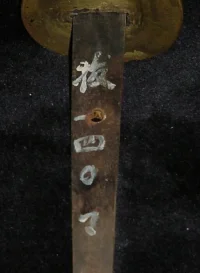
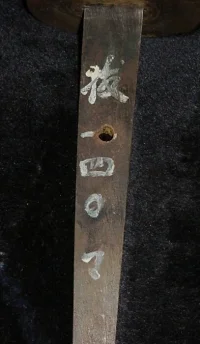
Can someone please translate this sword inscription?

thewizard-oz

後輩
Joined
15 Sep 2004
Messages
10
Reaction score
0
I have a samurai sword that my late father bought back from Japan in 1944 so it has been in my family for the past 60 years.

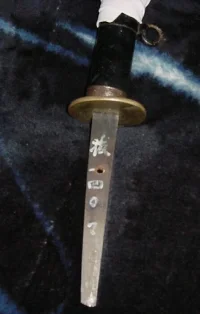
My sister and I would like to restore it and we recently removed the handle which revealed a hand painted inscription.

Could someone please translate these characters so that we can learn its history/background? The character names would also be nice.

I have attached images taken recently.

Thanks for any assistance. 🙂
 

Attachments

  • Sword 1.webp
    Sword 1.webp
    27.3 KB · Views: 674
  • Sword 2.webp
    Sword 2.webp
    37.4 KB · Views: 494
  • Sword 3.webp
    Sword 3.webp
    50.4 KB · Views: 499
world war 1 fighter/suicide sword? it has to be worth atleast ($80-american) my guess. my guess is that it's 60 years old and after the time of ww1. It's something i'd like to have. Before you restore it or try to make it look good, i would take it to an antiques dealer or someone who specializes in japanese swords. is the tip of the sword broken off?
 
No, the tip is not broken off, in fact, nothing is broken on it. My father, at some time, spray painted the scabbard and handle gloss black but otherwise it's as he received it in 1944 (or maybe 1945?).

My father was in the Australian Navy and was one of the first of the allied troops to set foot in Japan immediately after the atomic bombs were dropped. We have a photo album full of back and white photos of the destruction of Hiroshima and Nagasaki.
 
interesting, sad that he spray painted it, although the sword looks like it's in nice condition. i think it's a great find.
 
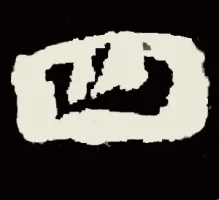
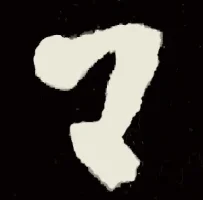
To me the first character looks like 抜 but I really can't be sure. Then it is just the numbers 1, 4, 0, and the katakana pronounced "ma" - マ. The numbers plus the katakana look like an index number.

I have no idea why 抜 would be written on it. It means "to remove" or "to be left out" and things like that. But it may be some other character. It's pronounced "nuki" (usually), or a close variation of that, or sometimes "batsu". To tell you the truth it looks more like hand radical on the left, then ム in the top right and 夂 at the bottom right, but that doesn't make any character I know of.
 
thewizard-oz said:
Could someone please translate these characters so that we can learn its history/background? The character names would also be nice.
The characters '抜140マ' makes no sense.
It was probably marked by the previous owner.
No one knows the meaning of the mark except the owner.
 
It may be some shorthand way of indicating the unit of the owner.
 
mikecash said:
It may be some shorthand way of indicating the unit of the owner.
A 'good old story' is that swords used to have a number written on the tang that denoted how well the sword tested after being forged. The test being that the sword would be be used to cut through a stack of corpses* and the number was how many it was able to cut through in one blow.

In which case 140 would be pretty damn impressive :D

* Or handy peasants if there aren't enough corpses around.
 
PaulTB: hehe, thats a good blade if that is so :P

got any more pictures like of the whole sword and the blade?
 
puKKa said:
got any more pictures like of the whole sword and the blade?

This is the 日本刀 section of an auction site.
There are lots of pictures of 日本刀.
(scroll down and you can see larger pictures.)
bidders.co.jp/list1/63901
 
thanks for responses people.

i'll take some more photos of the whole sword over the weekend and post them here.

wakaP: forgive my ignorance, but what is 日本刀 ?

thanks.
 
日本 = Japan (sun + root = "land of the rising sun", Nippon)
刀 = sword (and similar objects like knives)
 
yatta! katanas ^^
domo arigato WakaP!! :D :D

woooah!!!
bidders.co.jp/item/37987995
gimme.. :( :(
 
Enhanced character images

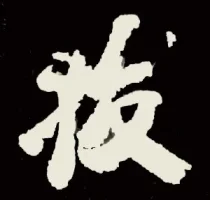
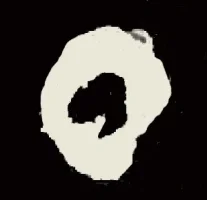
OK, attached are individual character images where i have enlarged them and used photoshop improve the contrast of the hand painted characters.

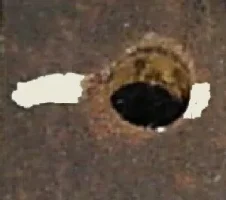
on 4 of them i have "paintbucketed" the backgrounds black for further contrast. i didn't do character 2 because it appears from a small spot of white paint on the lower edge of the hole that there may have been another stroke running vertically from the horizontal stroke befoer the hole was made. ? not sure, you guys would probably know if such a character exists.

character 1 - to me at least - does not look like the one that some you think it is, i.e. 抜. does it look like another character?

i appreciate your help. 🎈
 

Attachments

  • 1st Character.webp
    1st Character.webp
    5.2 KB · Views: 383
  • 2nd Character.webp
    2nd Character.webp
    8.8 KB · Views: 367
  • 3rd Character.webp
    3rd Character.webp
    4.5 KB · Views: 334
  • 4th Character.webp
    4th Character.webp
    3.6 KB · Views: 358
  • 5th Character.webp
    5th Character.webp
    3.7 KB · Views: 365
Well all I can do is quote myself: "To tell you the truth it looks more like hand radical on the left, then ム in the top right and 夂 at the bottom right, but that doesn't make any character I know of."

The ム may be a condensed form of some other component, but really you need a native speaker - though WakaP didn't disagree with 抜.

The other four are definitely 140+"ma" in my opinion. There's no character with a long horizontal line plus a short vertical line that could be hidden by the hole. Anyway they are much more likely to have been painted on after the sword was made (the hole would have been cut when it was made if you ask me). Sometimes kana characters like "ma" are used in indexing systems (like number plates). If I had to guess I would say it would be a serial number for the sword when it was issued by the army.
 
many thanks for you help Scrivener. :)

i know absolutely nothing about japanese characters or the japanese language :( but i'm sure that you're correct about the 140+"ma" characters being some sort of index or serial number and probably was issued by the army. i'm pretty sure that my father got the sword from japan when he was there is 1944 and doubt that it came from one the 4 or 5 kamakaze suicide aircraft that hit the ship was i was on - thererfore discounting that it previously belonged to a kamakaze pilot.

so, you suggest a "native speaker". hmmm....i'll just have to find one.:)

thnaks all. :)


it's just that first character that is a mystery...and bugging me.
 
My live-in native speaker said "find a specialist..." The kanji looks like one thing, but then there is this or that mark that might make it another or yet another (things get worse if the kanji is in cursive).

Any other numbers or stampings on the blade? If it was made by hand the inscriptions would be carved into the tang, and if it was machine made early in the war, stamped with numbers somewhere. I can't tell from the photos, but it does not look like you have a really old sword updated (altered) to fit a new owner or mountings, but again, with out better shots, it is hard to tell.

Any other modifications to the sword or its mountings aside from the spray paint?

If you really sink the cash to restore the blade (a specialist will also help you decide if it is worth doing so - the cost to restore might be far in excess of what the blade is worth) remember, the tang in off-limits.

Good luck!
 
Mandylion: thanks for your input.

i'm meeting up with my sister - the sword is at her house -this week and we plan to go right over the sword taking digital pictures that I will post here....that is if i am allowed to post several pics. :)

a couple of months ago my sister and i stumbled across a samurai sword polisher/sharpener her in perth, western australia. he gave us the name of a (?) degree black belt kendo exponent who restores samuari swords....the handle (tsuka) using stingray skin and cotton wrapping and scabbard (saya) with a high gloss black finish....to whom we took the sword to see if he could identify it but he couldn't apart from saying it appeared to be "some sort of military issue".
note: with my sister riding as passenger on my motorcycle "wearing" the samuari sword across her back, we were lucky no cops saw us! :)

it may be of interest and give an idea if the type of sword it is - until i can post detailed photos - that scabbard (saya) has 3/4" wide metal (steel) bands around it. there is one just in view with a steel ring attached to it in my first picture of my initial post at the top of this thread. there are 2 others spaced further along the saya.

thanks all! :)
 
The sword is most likely one of the el cheapo mass-produced jobs churned out for the Imperial Army during the war and almost utterly without value or merit for its "swordiness". Remember, they had thousands upon thousands of officers to provide with these things and master craftsmen working with an eye toward turning out a work of art every time just weren't going to be able to keep up with demand.

As has been pointed out though, anything you get from us should be taken with a grain of salt. An expert specializing in this sort of stuff will be able to give you the best information.
 
mikecash: yes mate, you're probably correct about it being a "mass produced" sword to a point.

the kendo exponent - "our samurai warrior friend" as we call him - that i mentioned previously did say that towards the end of world war 2, swordsmiths were busting their balls trying to produce enough swords top keep up with the demand and in many cases did not have the time to inscribe swords using the engraving method and instead simply hand painted (brushed) inscriptions of the swords. sounds logical to me. :)

so, while it may well be "without value or merit for its swordiness", it is at least a genuine sword, our father did bring it back from japan at the end of the war and does have some sentimental (?) value. :)

experts who are trustworthy are not easy to find in australia. i have been warned that some will be quick to say that your sword is worthless but then also waste no time in offering you a pittance to "take it off your hands". :)

while it may not be worth getting a sword restoration expert to do a complete "mint" restoration job on it - as far as collector's value is concerned - we may have it partially restored at least simply because these swords are an ancient art form eminating from the unique culture of the samurai warrior. it is a shame that some of their ideals are not prevalent in the world today. :(

anyway, the main thing for me at the moment is to identify all of the characters, work out what their combination means, where it was made and for whom, etc. :)

thanks.
 
The WW2 mass produced swords for the Imperial Army were not great quality swords. They were not folded anywhere as much as was really necessary, but they did their job. After the war tens of thousands of them flooded the west, mainly from American troops, when the soldiers were mustered out of the army as souviners. Due to this they are the most common sword to be found in the west and have little value. However be careful when looking at a sword that is claimed to be old, as I've seen many antique dealers trying to sell these WW2 swords and pretend they are older.

On the WW2 ones, particularly the ones produced further into the war, the scabbard (saya) is often metal instead of wood, and you can clearly see molding lines on it. Also the tsuba (the roundish bit that in the west we would call a hilt guard) is usually completely plain, whereas an older sword would generally have had at least a minimum of decoration to it.

From the quality of the tang (the bit of the blade that goes right down into the handle (tsuka)) I would say just looking at it that it is definitely a mass produced blade, and the level of corrosion on the metal would seem to support that. Also the patterns of the metal as seen through the hole (the tsuka pin hole, called a mesuki ana, with the wooden pin being the mesuki), it seems to be absent the striations that would be characteristic of artisan forging, however that could be a layer of corrosion obscuring it. Incidentally is the pin wood or metal? And did the tsuka (the hand guard piece) come off as one piece, two pieces, was it wrapped in cloth and rayskin or was it all metal?
 
Ben W Bell:

My father was in the Australian Navy during WW2 and didn't get the sword from American troops. As an indication of when he was in Japan, some of the photos that he personally took of the destruction and desolation resulting from the atomic bomb drops include pictures of charred human bodies. I am not certain, but he may have got the sword as the result of "disarming" a japanese soldier or sailor.

the saya is wood and in 2 halves, the the mesuki is wood. the tsuba is oval brass and the tsuka is one piece wood wiht criss-cross diagonal grooves in it and no ray skin or cloth wrap.

my sister and i are actually taking the sword to a guy here in perth, western australia, on this saturday afternoon so he can give us his opinion of the sword's origin. he is richard turner and has an extensive website on swords and kanji at
http://members.westnet.com.au/whiz/richard/Kanji/Kanji.htm
his site may be of interest to you guys and girls. :)

thanks for your comments :)
 
If you take some good close up pictures it should help. Often the best info is under the handle/grip if you can remove it without damaging it. Also , if you start your own separate thread , you may get a quicker reply. Be patient , sometimes it takes a while to get a reply. We have some super knowledgeable members here who can probably help you.
 
Back
Top Bottom