Casualty estimate for megaquake in Tokyo

thomas

Unswerving cyclist
Admin
Joined
14 Mar 2002
Messages
21,050
Reaction score
18,903
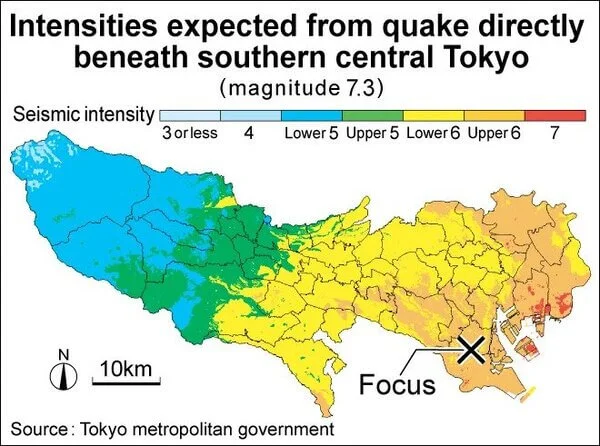
As if we needed that constant reminder: a disaster-prevention panel of experts working on behalf of the Tokyo Metropolitan Government estimates casualty rates of 6,200 if a megaquake strikes the capital.
tokyo-earthquake-prediction.jpg

Source: Asahi Shimbun

The first is an earthquake occurring directly beneath the southern city center of Tokyo. The second is a magnitude-7.3 quake occurring beneath eastern Tama, a suburb of Tokyo. The third is a magnitude-7.4 tremor occurring within the Tachikawa fault zone. And the fourth is equivalent to the magnitude-8 class Great Kanto Earthquake that occurred in 1923. The estimate for each scenario was based on it striking at 6 p.m. in winter and with a wind velocity of 28.8 kph, when the air is dry, and many people are lighting fires. In the first scenario, the focus of the earthquake would be near the southern part of Tokyo's 23 wards. About 60 percent of the 23 wards, mainly in the eastern and southwestern parts of the wards, would be hit by a seismic intensity of an upper 6. In some areas in the Koto, Edogawa and Arakawa wards, with rivers and bays nearby, the seismic intensity would reach 7. It is estimated about 6,200 people would die from the earthquake, while 194,400 buildings would be damaged by the quake or from fires, and 4.53 million people would experience difficulties returning home. But the latest damage estimate is smaller than the estimate the metropolitan government made in 2012.


That's a really tiny number if you think about it. If it's true, your odds are very good.
 
I guess it depends on many other factors: where precisely the epicentre is, how deep, etc. I remember another study that predicted that eastern Tokyo (all reclaimed land) would be severely affected by liquefaction and tsunamis. All evacuation zones for Koto-ku, Edogawa-ku, etc., were in Chiba, Saitama, or western Tokyo, so basically far away.

And this was reported just today:

 
The Metropolitan government revised its numbers this week:

New estimates released on 19 December suggest that a powerful earthquake of magnitude 7 or higher hitting the Tokyo area could claim up to 18,000 lives and damage or destroy around 400,000 buildings. Those numbers are lower than projections made in 2013, when officials warned of roughly 23,000 deaths and more than 600,000 buildings lost in a similar scenario that has long been regarded as a matter of when, not if.

Officials have linked the improved outlook to steady gains in seismic retrofitting and fire-prevention efforts over the past ten years. Even so, the assessment also makes clear that the government has not met its own target of cutting overall damage by about half by the end of the 2024 fiscal year, highlighting the extent of vulnerability that remains despite years of preparation for a major quake in the capital region.

The expert panel estimated the scale of damage if a magnitude 7.3 earthquake struck beneath Tokyo and registered a maximum seismic intensity of 7 on the Japanese scale of 7. Such a quake would have the greatest impact on the capital's core functions, and damage would be maximized if it occurred on a dry winter evening with winds blowing at 28.8 kph. Fires would cause roughly 70 percent of the deaths and building damage, the panel said. With Japanese society aging, more people are staying at home, leading to a higher estimated casualty count from building collapses and fires. The estimate also took into account the population growth in Tokyo and surrounding areas. Earthquake countermeasures, however, have advanced in the Tokyo area. For example, the proportion of residences with seismic reinforcement rose from 79 percent in 2008 to 90 percent in 2023.


The Tokyo metropolitan area has about 2,500 hectares designated as high-risk earthquake zones, mainly due to the concentration of older wooden housing. While the size of these areas has been reduced by more than 80% over time, they remain a point of concern. Estimates indicated that a major earthquake beneath the capital could inflict economic losses totalling around 83 trillion yen, with roughly 45 trillion yen stemming from damage to homes and business premises and a further 38 trillion yen resulting from prolonged disruptions to production and services caused by extended power and water outages.

The assessment also examined the impact of a larger quake of magnitude 8, comparable to the Great Kantō Earthquake of 1923, which claimed more than 105,000 lives. Under the most severe scenario considered, the report suggested that deaths could rise to about 23,000 and that as many as 414,000 buildings might be destroyed or burned down, illustrating the scale of destruction that remains possible despite decades of disaster-prevention efforts.

 
I wonder if those estimates would result in any migration to the suburbs/country where there would be potentially less chance of injury?
 
I wonder if those estimates would result in any migration to the suburbs/country where there would be potentially less chance of injury?
I doubt it. There was no observable shift after the 2011 earthquake, when parts of eastern Tokyo suffered from liquefaction. I really don't understand people who buy expensive apartments in the sky in places like Toyosu and Harumi, when the country is so vulnerable to earthquakes (which can make water supplies and elevators inoperable), storm surges due to tsunamis, and sea-level rises. I'm glad I live a long way inland.
 
Back
Top Bottom