Dozens

Mark of Zorro

先輩
Joined
4 Oct 2012
Messages
2,427
Reaction score
316
Base 10 sucks. It truly does. Oh, the way its written is convenient, but the number 10 itself is pretty crappy. Thus I have been a long advocate of a conversion to dozenal.

In this thread I would like you to tell me of any relationships in the world with the number 12. For example there are 12 months and 12 hours on your standard clock face. I like to point out these things to prove the usefulness of 12. Perhaps you know something obscure that I do not?

A good one I like to point out is that, excluding the thumb, people have 3 knuckles on each of their four fingers, for a total of 12 knuckles on each hand. By using the thumbs as markers, you can use this to count to twelve on your hand, or keep game scores using both hands, etc. Apparently, people in India have been doing this for centuries.

Another one is that there are 365 days a year, very close to 360, which is very neatly divided by 12 to get 30. And 30 being two dozen plus a half dozen. For this reason, I suggest six day weeks, where you get five days left over every standard year. This gives you exactly 5 weeks a month, with 5 months having a "leap day". Naturally, I suggest "leap days" be days off!

Any other relationships you can think of?
 
If you use binary you can count to 255 on your fingers, using your thumbs to pin down the '1' digits and letting the '0's go free. If you aren't worried about making it easy on yourself, you can just fold your fingers and thumbs, and then you have 10 bits and can count to 1023.

Combine that with the multiple-knuckles approach mentioned and the number you can count to on your fingers is... 2^24, 16777216. ; though you'd need to work out a careful scheme for thumb-placement to not miscount bits on the same finger when more than one was indicated.

If you're disciplined enough to use only the bending of the knuckles to indicate on/off you could go for being able to count on your fingers up to 2^28 ... aka 268435456. This is not for the faint of heart though, as it's quite uncomfortable and unnatural to straighten the fingertip when the other two knuckles are bent, making some numbers actually painful to count.

Personally, I use the 255 system sometimes. If I need to count more than that, I'll use a writing utensil or a computer.

12 may have other advantages, but binary is the winner for simple mechanical counting systems. ;)
 
Combine that with the multiple-knuckles approach mentioned and the number you can count to on your fingers is... 2^24, 16777216. ; though you'd need to work out a careful scheme for thumb-placement to not miscount bits on the same finger when more than one was indicated.

I cannot imagine needing to count so high on my fingers...nor spending so much time in gaining the Vulcan-like mental discipline it would require. As it is, one could count to 156 (left hand knuckes equal 12 each and right hand knuckles equal 1 each, 12 x12 +12 =156) and I think that is more than enough for any realistic practical application that any normal person could be expected to bother with.

Binary does win in the world of ELECTRONIC mechanical counting systems, but I am not so sure about such mechanical systems in general. And while we are on that subject, computers these days are based on binary, but convert things to base ten. I would like to see that changed to dozenal and I think it would be much more practical.
 
I would like to make it so we have 12 hour days where one hour is simply twice as long as now. The interesting thing about that idea is that the hour hand of an analog clock would always point to about where the sun is. 12 o'clock would stil be noon and the hand would point straight up toward the sun. But 6 o'clock would be midnight and the sun and the clock hand would be basically straight down. Seconds as they are now are kind of hard to count. But a second in such a scenario in base 12, with 12 hours per day (written 10), with 144 minutes per hour and 144 seconds per minute (each written 100) would be a steady tap-tap-tap that I think would be easier to keep track of.

Edit: There would be 2.88 dozenal seconds in one second as we have now by that scenario, so one second would be nearly three times as fast.
 
Last edited:
The Babylonians had 12 hours per day.

Here is a really good one for accountants. Since there are 12 months a year already, use of dozenal would result in fewer repeating decimals when doing financial calculations.
 
Any other relationships you can think of?
A dozen eggs
A dozen roses
A gross (144)
Old coin denominations in European countries, eg pence and shillings.
Have you ever heard numbers spoken aloud in French? It's very "four and twenty blackbirds", hinting at a past that used base 12, and maybe base 20 and base 60.

I think about dozenal a lot, and we had a brief conversation about it at JT (also your OP).

Frankly, dozenal is mostly something I doodle around with at night when I can't sleep. It hurts my brain to look at "16" and tell myself that it's a dozen-six, or a dozen and a half. This is the problem. We can add an 'A' and a 'B' for what we would call eleven and twelve in decimal, so 8,9,A,B,10 (where "10" is a dozen), but we're starting with a decimal system, and it's hard not to think in decimal.
It's like making fake meat out of tofu instead of just making something new from scratch. Or, maybe that's a bad analogy. ;-)

Fractions in dozenal hurt my head even more, but that is what I was thinking about in the wee hours this morning. Although I never think about the knuckle-counting mentioned in your OP, it is obvious that dividing by 3, 4 and 6 is a lot easier in dozenal.

We have 12 inches in a foot, but what's the deal with 3/8 and 5/8 of an inch, or 5/16"?
Was it just the right amount of spacing for those tiny increment lines on a ruler? No.
Turns out, eighths and sixteenths (as we call them in decimal) are very easy in dozenal.
Using a gross instead of base10's 100, we see that 18 is an eighth and 9 is one sixteenth. Operating on those numbers is easy.
The early carpenters in the West were onto something.

You can see the link at the following page for nice charts and sample notation, but if it hurts your head to think of "16" as a value eighteen in decimal or "a dozenSIX" aloud in dozenal, fractions will hurt more.
Key Dozenal Fractions | The Dozenal Society of America
 
Last edited:
We have 12 inches in a foot, but what's the deal with 3/8 and 5/8 of an inch, or 5/16"?
Was it just the right amount of spacing for those tiny increment lines on a ruler? No.
Turns out, eighths and sixteenths (as we call them in decimal) are very easy in dozenal.
Not to rain on the dozenal parade, but I don't think the fractions of inches - or the 16 oz. in a pound, or the units of liquid measure - have anything to do with dozens directly. It's just really easy to do physical measurements in powers of 2 - there are many ways to physically measure halves and doubles (balance beam, folded string, etc.) that don't apply to other multiples.
Decimal involves measuring fifths of things as well, and dozenal involves measuring thirds as well so I don't see much advantage either way.
Of course, with today's technology it's not like anyone making measuring instruments would resort to anything so simplistic as folded string and a balance beam, so it hardly matters now (hence the success of metric -most- places.)
 
You've got a point, Chris, especially about modern metric success. We won't change again until our robot overlords make everything binary.

However, the 16 oz in a pound and other weird measure units almost certainly do harken back to a time when other systems (base 16?) were used.

Decimal involves measuring fifths of things as well, and dozenal involves measuring thirds as well so I don't see much advantage either way.
Decimal only has divisors 2 and 5.
Duodecimal has 2, 3, 4, 6, a clear advantage. And, although you can't perfectly divide, say 8, into 12, it works a lot better because of the 4. Same for 16. And 9 works well b/c it's 3/4 of 12...need I go on? :-)
 
You've got a point, Chris, especially about modern metric success. We won't change again until our robot overlords make everything binary.

I dream of capitalizing on the stubbornness and my-way-or-the-highway attitude of the U.S. The U.S. won't convert to metric. So I wonder if the U.S. would go for the one upmanship of making an all new dozenal system? And you know the rest of the world would follow.

If we called it the "Patriot System" or the "America system" or something like that I am sure enough would salivate to make it law and even offer to go to war with any country that dared nay-say. (sigh).

However, the 16 oz in a pound and other weird measure units almost certainly do harken back to a time when other systems (base 16?) were used.

But it is hard to say why they used 16. Could have been anything. Its easy to be misled.

For example, some point out that teens start from 13 and eleven and twelve have their own unique term to prove that we once had a dozenal system. It turns out though that eleven and twelve are just corruptions from another language where they meant, if you will, "one teen" and "two teen".

We can add an 'A' and a 'B' for what we would call eleven and twelve in decimal, so 8,9,A,B,10 (where "10" is a dozen), but we're starting with a decimal system, and it's hard not to think in decimal.

Its like learning a new language. Its not that the new language is really harder, it just takes some getting used to. If one were born and raised with dozenal, no doubt decimal would make one's head hurt even more!

As for A and B, I don't like them. Even though we don't use them for numbers usually, we still use them commonly and that sows confusion. I would rather use * and # (from the telephone...12 keys!) or anything not so commonly used with a common meaning.

I have my own complete number writing system for dozenal. Unlike arabic numerals, the symbols are not random, but each based on a place in a symbol.

BTW, you made a mistake then corrected yourself. A and B are not eleven and twelve, rather they are ten and eleven. I have made that mistake myself so many times I see it instantly.

It hurts my brain to look at "16" and tell myself that it's a dozen-six, or a dozen and a half.

Try separating the 1 from the 6 in your mind. 6 is always half of 12. So the 1 is 12 and the 6 is, well, 6. That won't change for 26. The six will still be halfway to the next dozenal space of 30. 6 is the new 5!
 
Of course, with today's technology it's not like anyone making measuring instruments would resort to anything so simplistic as folded string and a balance beam, so it hardly matters now (hence the success of metric -most- places.)

I think it matters, and I think children should be taught such methods. The more logical and straightforward, the better, and dozenal would make it so.
 
BTW, you made a mistake then corrected yourself. A and B are not eleven and twelve, rather they are ten and eleven. I have made that mistake myself so many times I see it instantly.

Indeed I did. I have a calculator iphone app that lets you choose which base # to use, and it displays it below the decimal digits that you type, just like an English-Italian parallel text with one language on the left page, one on the right. It's very handy, but I have to remind myself which base I'm looking at sometimes. : - )

This app is also the source of the "A" and "B" symbols. I noticed some years ago that the dozenal society (ha!) used different symbols.
I should just use Greek letters or something. I'll probably draw a 4x3 grid next time I play with this.

You can look up the etymology of eleven and twelve at etymonline.com.

There's a bit of info on 16 ounces and the pound here: Avoirdupois - Wikipedia, the free encyclopedia
But only theories. You're right- we should be careful about the conclusions we draw.
 
Indeed I did.

I figured so, but in my mind, its really key and it takes practice. But on the other hand, I think the way people understand math and numbers is a bit different. I have a lot of trouble following the explanations most people give me concerning math. I had difficulty following my teachers. I usually relied on the textbook. Yet, math was easily my strongest subject until my second year of high school, partly because I lost interest.

Flip side is, people don't usually get my explanations either.

In other words, the best path for you may only be found by you. Still hope to be of some help though!

but I have to remind myself which base I'm looking at sometimes. : - )

I understand that sentiment very well! I had that trouble when trying to determine what (I think) is the best way to have a dozenal time system. I was always asking myself if that is standard minutes or Zorro dozenal minutes, sometimes finding calculations were way off for using the wrong set! Then having to go back and do half of it over again!
 
Photo-0158.webp

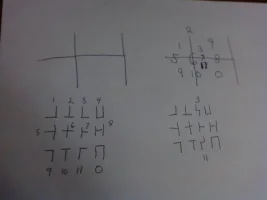
Here are my numbers and the symbol it is derived from on paper. Upper left is the symbol, upper right shows the location the symbols derive from, bottom left shows the numbers themselves, and bottom right shows the adjustments I had to make to fit it with my alphabet. It just so happened that my notations for 3 and 11 were already in use.

The symbol itself is derived from the human hand. If its a right hand facing palm to you, then the first vertical line is the ring finger and the second is the pointer finger. The pinkie and middle finger are in the spaces. The vertical line is the center knuckle on each finger. Not that it makes that much sense, but that is how I came up with that shape; trying to find some approximation with the hand. My entire alphabet is based on hand shapes, so I wanted the number system to be so as well. Oh well, I basically failed at that but still came up with something easy enough to remember, with a central theme to tie it all together.
 
You've put some time into this! I usually don't do much more than encounter a number and then start wondering what it would be in dozenal.

I understand that sentiment very well! I had that trouble when trying to determine what (I think) is the best way to have a dozenal time system. I was always asking myself if that is standard minutes or Zorro dozenal minutes, sometimes finding calculations were way off for using the wrong set! Then having to go back and do half of it over again!

In that sense, it's harder than learning a foreign language. Unless one devises an entirely new system of symbols like you did, it's as if you're learning a language in which all the words are spelled just like your native words (or kanji) but with completely different meanings.
When I first got into dozenal, I remember inventing different sounds for the first 20 numbers (that's "18" to you) so that I wouldn't have to say or think words like "sixteen." No idea where those notes are now. Probably on a discarded placemat.
 
I was just thinking, we could base the new names on the months of the year, but that is also messed up. While there are twelve months, Octo means 8, not 10; Nov means 9, not eleven, and Dec means 10. So much for that :LOL:. We'd have to have duodecember.
 
Since there's 24 hours in a day, 12, 4, 2, 1, 3, are quite handful numbers to ease us nurses in administering drugs to our patients.
 
You've put some time into this!

I have! I am not decided on if I am a fool for doing so, or if I have reaped worthwhile fringe benefits. I used to have a dozenal website, not that anyone ever visited. But I did learn how to make and publish a basic website.


.
When I first got into dozenal, I remember inventing different sounds for the first 20 numbers (that's "18" to you) so that I wouldn't have to say or think words like "sixteen." No idea where those notes are now. Probably on a discarded placemat.

The readings of the numbers, yes, that is an all important basic point. I have perused the websites of both the Dozenal Societies of Britain and America and I don't remember seeing anything about that. So I also made my own.

My solution is to use zero to eleven as usual. 10 can be read twelve, dozen or doz (like does). Then 11 is simply one dozen one, or one doz one for short, then one doz(en) two, one doz(en) three....20 is two doz(en)...probably best to stick with using the full word "dozen" on round numbers, then two doz(en) one, etc. all the way up to eleven doz(en) eleven which is BB in your app's notation.

After that I just use hundred, but yes, probably something new would be better.

twelve months, Octo means 8, not 10; Nov means 9, not eleven, and Dec means 10. So much for that . We'd have to have duodecember.

Yeah, the month names! Did you know there used to be 10 months, but July and August were added to make it 12? July for Julius (Caesar) and August for Augustus (Caesar) thus pushing September from the 7th month to the 9th, etc. But what is done is done. Octo also means "ten" now if we admit reality, so why not?
 
Since there's 24 hours in a day, 12, 4, 2, 1, 3, are quite handful numbers to ease us nurses in administering drugs to our patients.

I would never argue with someone who has "12" right in her name. : - )

I am not decided on if I am a fool for doing so, or if I have reaped worthwhile fringe benefits.
In my view, not everything has to be a means to an end. If you're enjoying yourself, that's good enough. And one day it might serve you. I guess I'm a Tao of Pooh kind of guy.

My solution is to use zero to eleven as usual. 10 can be read twelve, dozen or doz (like does). Then 11 is simply one dozen one, or one doz one for short, then one doz(en) two, one doz(en) three....20 is two doz(en)...

For (base 12) 14, I think I had something like do'ver, which is what I imagined to be the evolution of decades of saying "a dozen four". I used some French & Spanish roots, too, both to make some of the words flow off the tongue and also to get away from the English decimal terms that are so burned in.
 
Very interesting. Thank you for the link.

I don't think binary is very useful for humans like it is for machines. And so basing another number system's symbols on binary seems rather odd to me. The symbol one is understandable, and so is two. But three is like changing a decimal place but its before the real change of decimal place that is from 7 to 8. I would rather have 8 symbols that make a straight line from 0 to 7, even to the point of one new stroke for each new symbol.

And I don't find much advantage with octal itself either. I find it to be about on par with decimal in the end. Not so much use for the ability to divide by two over and over, or multiply and always get zeros.

Criticism aside, that was interesting to contemplate, so thanks again for the link!
 
Back
Top Bottom