Question Hello There... It's Yah Boi... :D

トレバー

後輩
Joined
30 Mar 2024
Messages
245
Reaction score
328
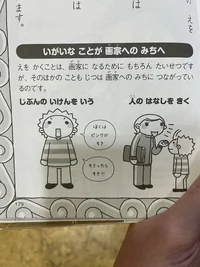
Hey all, it's been a while since I've last posted, but I've been a busy bee, buzz buzz, reading a bunch of Japanese at my level. I recently tried jumping to more difficult material because I was really feeling myself, not literally, and felt like I could handle it... well... shucks... I got humbled, homies... that Japanese spread me like fine jelly on toast, and I had to return to 2nd grade reading material. :D
I could hang for a little bit in the harder material, but if I have to look up like almost every word, ugh... it's not really reading anymore.

I was wondering if you all had any general tips for reading? :D What do you guys do? (and gals, hey hey ladies. ;) )

Thanks so much for your help and advice over all of this time!
 
Treavor,

The frustration level for reading is 90 percent. If you understand less than 90 percent of something, it's too hard. Keep building up your reading level with something easier,
 
What do you guys do?
I gave up reading Japanese decades ago. I don't have time to read the material in English I want to read let alone Japanese. So my Japanese reading is limited to my wife's texts and work emails mainly.
 
I gave up reading Japanese decades ago. I don't have time to read the material in English I want to read let alone Japanese. So my Japanese reading is limited to my wife's texts and work emails mainly.
Oh yes, that's right, I remember you typing that before! :D
 
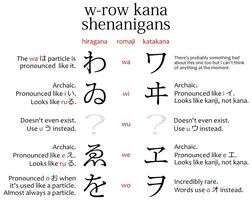
Does anybody know why they don't use the characters in this image anymore? :D
 

Attachments

  • w-row-kana.webp
    w-row-kana.webp
    37.4 KB · Views: 60
Does anybody know why they don't use the characters in this image anymore? :D
sometimes, languages change over time to adapt to the way they are used, and languages almost always lean towards what's easier and more natural to pronounce.

The bilabial approximate "w" can easily be elided (unspoken) depending on the phonetic context. Say "wa, wi, wu, we, wo" over and over, faster and faster, then do the same thing for "a, i, u, e, o." At a certain point, it will be difficult to distinguish the sounds with and without the "w."

Since Japanese syllables almost always end in a vowel, the "w" in these kana would often be sandwiched between vowels, making them harder to speak, and also harder to hear at times. The only one that stands out amongst these is "wa," which is why it still exists in the Japanese syllabary ("wo" is still kicking around but it's almost always used to distinguish it as a particle, and that is not even pronounced with the [w]")

In English, misspellings caused by mishearing can make their way into the lexicon and eventually become accepted and even "proper" spellings. We can see some of these changes happening in Japanese as well, as "atashi" has become an acceptable feminized form of "watashi," with the [w] elided. Without a lot of minimal pairs (two distinct words that are identical except for one sound), the need to clearly enunciate the sound is diminished, which can lead to the sound changing or disappearing altogether in some dialects. This is one mechanism for how accents develop, and why the way we speak is often a reflection of where we're from, how well-off our family was, and the "quality" of our upbringing and education.
 
Does anyone know if Leiouyuuwa is Cantonese? I've heard Japanese people say this and I guess it means I love you, or thank you very much? Hmmmmmmm
 
Has anybody noticed that sometimes you might come across some Kanji that is not in compound form, and you just can't remember the pronunciation to save your life? Grrrrrr, frustrating.
 
Have you guys ever heard of the website TODAKU? It is filled with free books to read at varying levels?! I was like say whaaaaaaaaaaaaaaaaaaaaaaaaaaaaaaaaaaaaaaaaaaaaaaaaat?! :o I'm enjoying myself, but it seems like I'm still at level 1, HAHA.
 
Back
Top Bottom