News Prince Hisahito undergoes coming-of-age rites

thomas

Unswerving cyclist
Admin
Joined
14 Mar 2002
Messages
21,050
Reaction score
18,904
Prince Hisahito, nephew of Emperor Naruhito and second in line to the Chrysanthemum Throne, took part in a series of traditional coming-of-age ceremonies on Saturday, becoming the first male member of Japan's imperial family to undergo such rites in about four decades. The prince turned 18 in September last year, making him the first male in the imperial household to reach adulthood since his father, Crown Prince Fumihito, did so in November 1985. However, the official ceremonies were postponed for a year to avoid clashing with his university entrance exam preparations.


One of the central rituals involved the conferral of a crown symbolising adulthood. In this rite, attendants removed a black silk headband from the seated prince. They replaced it with the crown, which Emperor Naruhito formally bestowed. The ceremony was attended by the emperor and Empress Masako, together with the prince's parents, Crown Prince Fumihito and Crown Princess Kiko, who all bore witness to the moment.

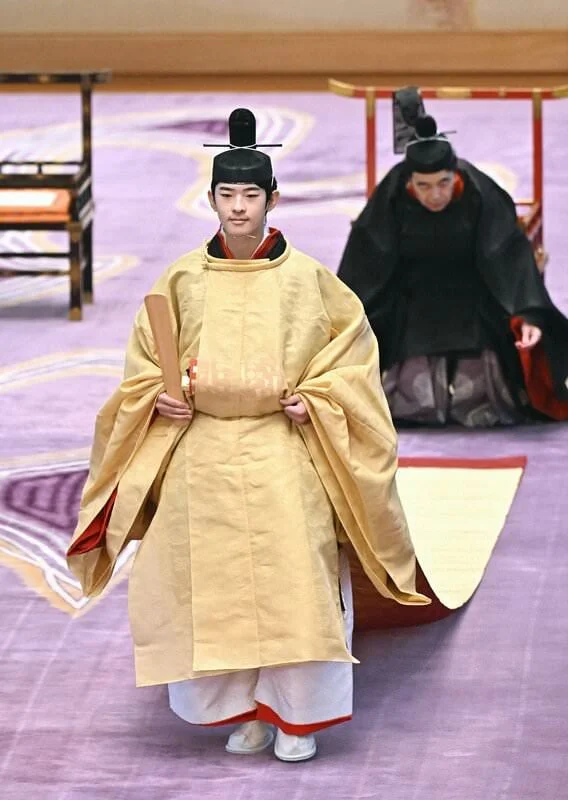
The prince then changed into adult ceremonial attire and rode in a state carriage to the Imperial Palace Sanctuaries to perform formal worship in honour of the family's ancestors. In the afternoon, he will have an audience with the emperor and empress in the prestigious Matsu no Ma stateroom of the Imperial Palace. He will also be awarded the Grand Cordon of the Supreme Order of the Chrysanthemum. The prince will later go to greet his grandparents, former Emperor Akihito and former Empress Michiko, who reside at the Sento imperial residence in Akasaka. A private celebratory banquet will be held in Tokyo in the evening. Prince Hisahito was the first imperial family member to reach adulthood under Japan's revised Civil Code, which lowered the age of adulthood to 18 from 20, effective April 2022.

Prince Hisahito coming of age


Prince Hisahito coming of age


【ノーカット】悠仁さま成年式「加冠の儀」 40年ぶり宮中儀式

He has been attending the University of Tsukuba since April, pursuing his long-time interest in insects at the School of Life and Environmental Sciences. Adult members of the imperial family engage in official duties and attend imperial ceremonies, but as female members lose their royal status upon marrying a commoner under the Imperial House Law, their number has been dwindling.


After touring Ise Jingu , Hisahito visited the Musashi Imperial Graveyard (武蔵陵墓地 Musashi ryōbochi) in Hachiōji.

Hisahito visits ancestral sites after coming-of-age ceremonies

Dressed in formal Western attire with a silk top hat, the prince bowed before the Musashino Mausoleum in Hachiōji, the final resting place of Emperor Shōwa, his great-grandfather. Hisahito is the son of Crown Prince Fumihito and Crown Princess Kiko, and the nephew of Emperor Naruhito. He is second in line to the Chrysanthemum Throne. The visit served as an official report on the completion of his coming-of-age ceremony that took place at the Imperial Palace on Sept. 6, his 19th birthday. About 100 well-wishers gathered outside the tomb complex to celebrate the special occasion for the future emperor. Hisahito went on to visit and pay tribute at nearby tombs of Emperor Taishō; his wife, Empress Teimei; and Empress Kojun, the wife of Emperor Shōwa.


I asked ChatGPT whether the imperial mausoleum was open to the public:

The Musashi Imperial Graveyard in Hachiōji, Tokyo, is open to the public. Visitors can walk through the grounds and pay their respects at the mausolea of Emperor Taishō (1879-1926), Emperor Shōwa (1901-1989), and their consorts. Access is permitted during set hours, generally from morning until late afternoon. However, entry into the actual mausolea areas is restricted—you can only approach as far as the designated paths and viewing areas. The atmosphere is quiet and solemn, more like a large wooded park than a typical cemetery, and photography may be limited in certain parts.
  • Open daily from 9:00 AM to 4:00 PM, with last entry at 3:30 PM.
  • Entry is free of charge.
  • Occasionally, the graveyard is temporarily closed due to imperial events.
 
Wonderful! The Japanese love an ancient ceremony as much as the British, it seems. Is there an explanation of the detail of what goes on during this ceremony?
 
Is there an explanation of the detail of what goes on during this ceremony?

1. Imperial Palace Sanctuaries

  • On his 19th birthday (6 September 2025), Prince Hisahito participated in the Kakan-no-Gi (冠を賜うの儀), the crowning ritual held at the Imperial Palace. He received a traditional "kanmuri" (adult crown) from an envoy of Emperor Naruhito.
  • Following the ceremony, he travelled by horse-drawn carriage to pray at the Three Palace Sanctuaries located within the palace grounds, making offerings at three shrines—a sacred rite marking his new adult status.

2. Ise Jingū (Gekū and Naikū)

  • On 8 September, he visited Ise Jingū to pay respects to Amaterasu-ōmikami, the ancestral deity of the Imperial Family. He first went to the Outer Shrine (Gekū), then to the Inner Shrine (Naikū).
  • At the Naikū, he walked through the approach past the Kaguraden (hall for ceremonial music) and offered a tamagushi—a ceremonial branch—for prayer at the Shōden, the main sanctuary.

3. Musashi Imperial Graveyard (in Hachiōji)

  • On 20 March 2025, earlier that year, Prince Hisahito visited the Musashi Imperial Graveyard to report his high school graduation formally. He offered a tamagushi at the tombs of Emperor Shōwa and Empress Kōjun (and at Empress Kōjun's eastern mausoleum).

The Tamagushi Offering (玉串奉奠 tamagushi hōten)

  • A tamagushi is a ritual branch of the sacred sakaki tree, decorated with white paper streamers (shide) that symbolise purity and the presence of the kami.
  • In a rite, the worshipper presents the branch at the altar by rotating it—first half a turn clockwise, then laying it carefully with both hands. This gesture shows utmost reverence, as if uniting human sincerity with the spirit world.
  • For members of the Imperial Family, the offering carries an additional meaning: it is not only a personal prayer but also an act performed on behalf of the state, since the emperor and his heirs stand as ritual intermediaries between the kami and the people.
  • In Prince Hisahito's case, offering a tamagushi at Ise Jingū and the Musashi Imperial Graveyard signified his personal gratitude and his formal announcement of adulthood to the divine and ancestral protectors of the Imperial line.

The Three Palace Sanctuaries (宮中三殿 kyūchū sanden)

These shrines stand within the Imperial Palace grounds and form the sacred heart of the court's ritual life:
  1. Kashikodokoro (賢所)
    • Dedicated to the Yata-no-Kagami, the Sacred Mirror, which represents Amaterasu-ōmikami.
    • It is the most sacred of the three sanctuaries and the place where emperors traditionally report key life events to the Sun Goddess.
  2. Kōreiden (皇霊殿)
    • The Ancestral Spirits Shrine.
    • It enshrines the spirits of successive emperors and imperial family members, functioning as a dynastic memorial.
  3. Shinden (神殿)
    • Dedicated to all the myriad kami of heaven and earth, acknowledging the broad Shinto pantheon that supports the realm.

When Prince Hisahito made offerings at the Kyūchū Sanden after the Kakan-no-Gi in September 2025, he was symbolically addressing the kami, the sun goddess, and his imperial ancestors all at once—thereby linking his personal passage into adulthood with the unbroken continuity of the imperial tradition.


The above is from ChatGPT and not fact-checked.
 
Here's a quick rundown of the royal family's assets.

The Japanese Imperial Family is supported by taxes and has no income of their own. Therefore, the Imperial family does not have any huge accumulated assets.

All equipment used in the ceremony are national property of the Japanese state. Even the house they live in.

The former Emperor loved to drive a car. During the ceremony, the Emperor sits in the back seat of a car. The price of this car is 10 million yen. Of course it is the property of the state.

Goryou-sya "御料車"

However, when the former emperor was driving a car, he bought it himself. The price of the car is 1.2 million yen. The Emperor does not have much money to spend personally. Because the money that the Emperor can use personally is also tax money.

The Emperor's Car - Honda Integra

So why doesn't the Japanese Imperial Family have any assets? The reason is that it has been over 800 years since the Japanese Imperial Family last ruled the country. Since the birth of the samurai government, the assets of the Imperial family have continued to decline. And during the Edo period , the Imperial family was finally controlled by samurai. The Imperial family's assets were abolished, and the operating costs were covered by the shogunate.

During the Meiji period , the imperial family's property was restored, but they did not have the right to use it freely. This is because the rulers had simply changed from samurai to politicians, and the Emperor no longer had any real power. Now, all of the Emperor's assets are managed by the government.

NANGI
 
Here's a quick rundown of the royal family's assets.

The Japanese Imperial Family is supported by taxes and has no income of their own. Therefore, the Imperial family does not have any huge accumulated assets.

All equipment used in the ceremony are national property of the Japanese state. Even the house they live in.

The former Emperor loved to drive a car. During the ceremony, the Emperor sits in the back seat of a car. The price of this car is 10 million yen. Of course it is the property of the state.

Goryou-sya "御料車"

However, when the former emperor was driving a car, he bought it himself. The price of the car is 1.2 million yen. The Emperor does not have much money to spend personally. Because the money that the Emperor can use personally is also tax money.

The Emperor's Car - Honda Integra

So why doesn't the Japanese Imperial Family have any assets? The reason is that it has been over 800 years since the Japanese Imperial Family last ruled the country. Since the birth of the samurai government, the assets of the Imperial family have continued to decline. And during the Edo period, the Imperial family was finally controlled by samurai. The Imperial family's assets were abolished, and the operating costs were covered by the shogunate.

During the Meiji period, the imperial family's property was restored, but they did not have the right to use it freely. This is because the rulers had simply changed from samurai to politicians, and the Emperor no longer had any real power. Now, all of the Emperor's assets are managed by the government.

NANGI
Good heavens! I wonder if they use a food bank 🤔 I could lend then a tenner if they like.
 
Back
Top Bottom