Kazahana vs Kazehana

Sanmayce

old boy
Joined
4 Jan 2008
Messages
11
Reaction score
1
Hi to all,
I am very interested in what is the difference (if any) between these two words.

Sadly my Japanese vocabulary is comprised of only 100 to 200 words.

As far as I speculate the first means 'snowflake/snowflower' whereas the second 'windflower', but I see them written using two identical glyphs: 風花.

While searching the Japanese net for nuances of Kazahana, one very cuore doll named 風花 Kazahana popped up:

500x1000px-LL-50e8750a_03202254_4d860706a32ed.webp

The Japanese doll masters amaze me endlessly, this beauty is made by 'Rose Moon' figurine workshop.
Thus far I found that "Kazahana" means literally "snowflake", while ISO8 (the train enthusiast from Japan) gives another meaning: the phenomenon of snowflaking in a sunny day. As I see it is used to denote purity, or as SOED defines it:
The state of being morally or spiritually pure; freedom from moral or ritual pollution; chastity; an instance of this. ME.


So my question:
Are these three definitions valid?
- snowflower
- windflower
- snowing in a clear day
 
Hi to all,

So my question:
Are these three definitions valid?
- snowflower
- windflower
- snowing in a clear day


"Kazahana" (or "kazabana"--same word different reading, probably depending on the locality) is a meteorological phenomenon in which snow falling in a location quite remote from you is blown by strong winds and flutter in the sunny sky above you. Therefore, it is "snow flower," and "wind flower" and "snowing on a clear day."

This doesn't happen everywhere but occurs in certain parts of Japan where the conditions are right for the phenomenon to happen. I've seen it in Kyoto and Gunma, but not in Tokyo where I live.

Because of the beauty and romance of snowflakes glittering in the sun, Kazahana is popularly used as names of products, stores, etc. That is the reason why you saw it used for a doll.

I think that explains it? Also, "kazehana" is probably a misreading. I've never heard it read that way.
 
Thanks a lot epigene, I really needed to know.

I think that explains it? Also, "kazehana" is probably a misreading. I've never heard it read that way.

Yes it does, you can hit the 'listen button' in order to hear how Google translator pronounces it:
Google Translate
For some reason the link discards the 風花, you need to paste them into left box.

AFAIK Kazehana is an Anime/Manga character, so it is not wrong.
490825.webp

And please tell me how come that 'Kaza' is used instead of 'Kaze', the latter denotes 'wind', right?
Also, why Google translates 風花 to 'fuka'!?
Since I know only up to 200 Japanese words, at least I want to know them right.
 
Google Translate is horrible, that's why haha. However, 風花 can also be the female name Fuuka. Also, while the "speaker" says "kazehana", the reading displayed below the textbox is "kazabana", so it's likely just a flaw in their speech program that just picks a common reading for the individual characters.

EDIT: Also, kanji tend to have multiple readings (usually at LEAST 2, often 3 or 4, and not uncommonly more). For example, 風 can also be read "fuu" as in 台風 (taifuu / typhoon) and probably in other ways as well. It's actually a bit (though not terribly) surprising that it's read "kazabana" to begin with since those are both 訓読み (kunyomi / Japanese reading). Often (though not always) compound words use the 音読み (onyomi / Chinese reading), so ふうか makes a lot of sense since those are both 音読み.
 
かざ is only used in compound words such like 風上[かざかみ], 風下[かざしも], 風向き[かざむき], 風見鶏[かざみどり]. It's an allomorph of かぜ.
 
😌 Thanks guys, but you greatly overestimated my skills, I am an absolute beginner.


For the first time I looked at hiragana table:
ka ze: か ぜ
ka za: か ざ


So I wrote it myself:
KAZAHANA - 風花 [かざはな]
KAZEHANA - 風花 [かぜはな]
But Jim Breen's WWWJDIC gives:
風花 【かざばな; かざはな】
He omitted the 'KAZE' variant, :( why!?


My 'FLOWER'-related questions:


アネモネ (n) anemone (lat.); windflower
菊 【きく】 (n) chrysanthemum (Chrysanthemum morifolium);
しゅうめいぎく 《秋明菊》 (n) (uk) Japanese anemone; Anemone hupehensis var. japonica
The first line is what I have sought:
Wikipedia defines 'anemone' as:
According to the Oxford English Dictionary, Greek anemōnē means "daughter of the wind", from ánemos "wind" + feminine patronymic suffix -ōnē.
HERITAGE defines it as:
anemone n.
1. Any of various perennial herbs of the genus Anemone, native chiefly to northern temperate regions and having palmately lobed leaves and large flowers with showy sepals. Also called windflower.
2. A sea anemone.
[Latin anemōnē, from Greek, probably from anemos, wind (perhaps because the petals are lost easily in wind); see anə- in Indo-European roots.]


1] So, does KAZAHANA literally mean 'anemone'?!
2] Is there in Japanese this beautiful bond between "WIND" and 'SOUL/ANIMA' as in Indo-European languages?
WIND copy.webp


Also, what is the exact connection between 'KAZAHANA' and 'snowflower'? I mean that 'KAZAHANA' can be either 'snowflower' or 'windflower'. Can we use 'KAZAHANA' to denote snowflake?

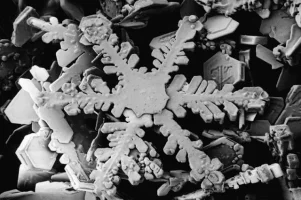
A photograph of actual snowflake under a microscope!
800px-Snowflake_magnified_usda.webp

雪片 【せっぺん】 (n) snowflake
雪花; 雪華 【ゆきばな(雪花); せっか】 (n) snowflakes
雪 【ゆき】 (n) snow;

I see in second line '花' preceded by '雪' i.e. we have 'snowflower' vs 'windflower' or 雪花 vs 風花.
 
Last edited:
He omitted the 'KAZE' variant, :( why!?
Since kazehana is wrong, as already poined out.

1] So, does KAZAHANA literally mean 'anemone'?!
No. Kazahana has nothing to do with anemone.

2] Is there in Japanese this beautiful bond between "WIND" and 'SOUL/ANIMA' as in Indo-European languages?
No.

Also, what is the exact connection between 'KAZAHANA' and 'snowflower'? I mean that 'KAZAHANA' can be either 'snowflower' or 'windflower'.
Kazahana is a meteorological phenomenon, as epigene-san already explained.

Can we use 'KAZAHANA' to denote snowflake?
Therefore, No.

雪片 【せっぺん】 (n) snowflake
雪花; 雪華 【ゆきばな(雪花); せっか】 (n) snowflakes
雪 【ゆき】 (n) snow;

I see in second line '花' preceded by '雪' i.e. we have 'snowflower' vs 'windflower' or 雪花 vs 風花.
花 doesn't refer to actual flowers in these cases. it's more likely "flower-like/looks like a flower".
 
First off, I don't need answers if my questions are boring you.

Since kazehana is wrong, as already poined out.
Who pointed that out, and how!!

Kazahana is a meteorological phenomenon, as epigene-san already explained.
Wow, it seems that I am much dumber than I thought

Therefore, it is "snow flower," and "wind flower" and "snowing on a clear day.
That's why I am continuing to seek the connection between 'snowflake' and 'flowers'.

Is there in Japanese this beautiful bond between "WIND" and 'SOUL/ANIMA' as in Indo-European languages?
kaze.webp
The above shot is taken from a playful audio-video mix on youtube featuring Kazehana, the affection shown in this sentence clearly suggests a DIRECT connection between WIND and SOUL. Unfortunately I can't bring more examples, yet I believe more exist.

And I don't want to be rude, but Toritoribe please don't answer to my questions.
 
Having read the short Kazehana profile: List of Sekirei characters - Wikipedia, the free encyclopedia

I see there is a hidden offending nuance,don't know what exactly, though.

"Her name literally means "Wind Flower", with Miya's nickname for her being "Public Obscenity".[6] Her Jinki (numbered #3) was a prize for the winner of the third match of the Third Stage and is currently in Minato's hands (which is his second Jinki).[33] Her known attacks is the Flower Whirlwind (花旋風, Hana Senpū?),[34] Flower Dance (花の舞, Hana no Mae?), Flower Feast (花宴?), and Cherry Flower (花桜?) ..."

I still have not seen these comedic anime episodes, but they appear interesting.
In the youtube clip I saw her using 'flower refuge' and 'flower banquet' special powers, which is which compared with Wikipedia's definitions!
I like a lot these word-combos:
花旋風
花の舞
花宴
花桜


Wikipedia is uncertain, though, about their meaning/spelling - they all end with '?'.
 
So simply because he is countering what you know to be "true", you don't wish for him to answer your questions. I think this is what you call believing whatever you wish and then looking for the evidence to support it. But, you don't have to listen to me either for that matter.
 
Back
Top Bottom