


- 15 Mar 2002
- 22,919
- 472
This thread is for the general discussion of the Article The Great Kantō Earthquake of 1923. Please add to the discussion here.
Follow along with the video below to see how to install our site as a web app on your home screen.
Note: This feature may not be available in some browsers.

Today, it is 100 years since the Great Kantō Earthquake of 1923, the worst natural disaster in the history of Japan. It wiped much of Tokyo and Yokohama off the map and touched millions of people—just the number of homeless people came to almost 2 million. The monetary estimate of the value of the destruction was four times larger than the entire national budget.
The most terrifying result of the earthquake was a surge of devastating fires. Within minutes after the first shock, some 134 fires spread in Tokyo alone. They were caused by overturned charcoal fires set up to cook lunch, ruptured gas lines, as well as explosions of chemicals at laboratories and drugstores.
The fires turned half of Tokyo and most of Yokohama into an empty black wasteland. Almost 90 per cent of the 105,000 victims of the Great Kantō Earthquake burnt to death.
One young woman documented how these fires terrified and destroyed the city around her in a detailed account of her escape. Her name was Nobu Matsumoto. Nobu lived in Tokyo's Honjo Ward (current Kōtō Ward) with her husband Tsurukichi, son Isao, and daughter Shizuko.
Just before noon on Saturday, September 1, the 29-year-old Nobu sat down for lunch with her husband and two children. Usually, she had lunch just with her children. But today, her husband had a day off, and they were looking forward to eating together. They never got the chance. After sitting down, their ordered life descended into unimaginable horror and chaos.
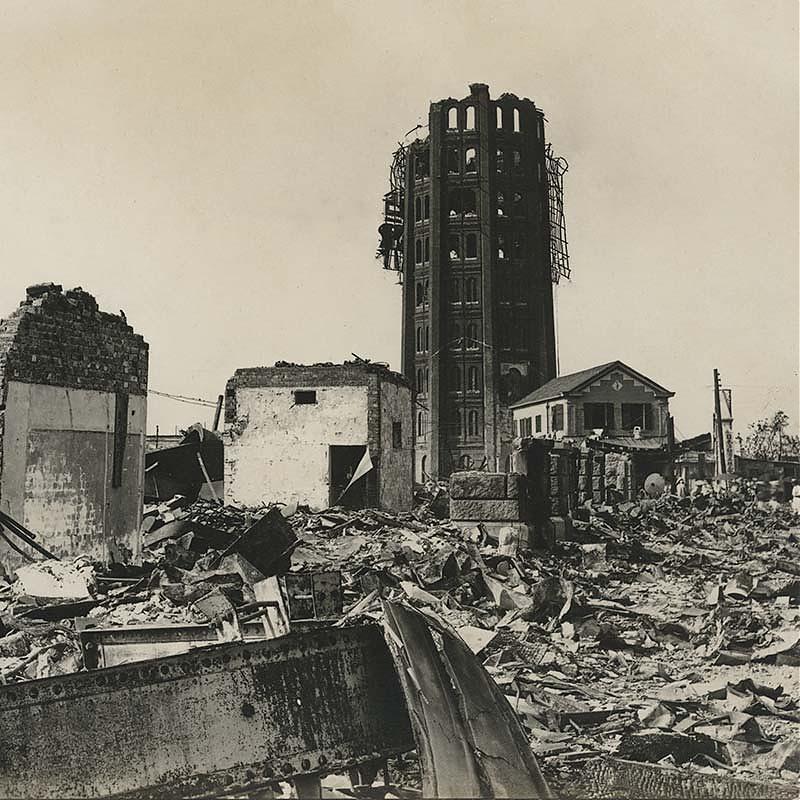

 asia.nikkei.com
The silent film was shot by photographers including those belonging to the "motion picture team" of the Osaka Mainichi Shimbun, a predecessor of the Mainichi Shimbun. The film, archived by Mainichi Productions, was recently released to commemorate the 100th anniversary of the Great Kanto Earthquake, one of the worst natural disasters of modern Japan.

Sept. 1 marked the 100th anniversary of the 1923 Great Kanto Earthquake, yet neither the Japanese government nor the Tokyo Metropolitan Government are willing to sincerely face the history of Koreans and others massacred in the quake's aftermath. Chief Cabinet Secretary Hirokazu Matsuno said at a regular press conference late last month, "We have found no records within the government that would allow us to confirm the facts," and indicated that the government did not intend to reinvestigate the issue. Tokyo Gov. Yuriko Koike has repeatedly stated in the metropolitan assembly that "it is up to historians to find out what the clear facts are." This year, again, the metropolitan government refused to send a letter of condolence to a ceremony organized by a civic group to commemorate the slain victims.

Masataka Tanaka, a specialist in modern Korean history at Tokyo's Senshu University, said, "It's outrageous to say there are no records." He continued, "This government is the only one saying there are 'no records.' Among researchers and those who've investigated the massacre, nobody says anything like that." In fact, historical records of the massacre are stored in places such as the National Diet Library and digitalized materials can be browsed through at the Japan Center for Asian Historical Records, managed by the National Archives of Japan.

According to the association and other sources, the survey sheets measure approximately 10 by 15 centimeters, and contain the names, gender, addresses and places of death of the victims. A total of about 50,000 sheets remain, and excluding duplicates, information on 38,826 people has been recorded. The earthquake that occurred on 1 September 1923, left some 105,000 people dead or missing, and about 70,000 people perished in Tokyo alone. It is said that some of the dead were cremated without being identified amid the confusion.

The Army Ministry carried out the survey in November 1923, about two months after the temblor. The materials were discovered by journalist Nobuyuki Watanabe within the Military Archives at the Ministry of Defense's National Institute for Defense Studies (NIDS). The materials show that more than 40 ethnic Koreans among those who were being taken to a police station in what is now Kumagaya, Saitama Prefecture, ostensibly for their safety, were murdered en masse. Notes include, "A bloodthirsty mob slaughtered every one of them." The report uses a derogatory term for Koreans and refers to the killings as "massacre," "wrongdoing" or "illegal conduct," but also states that Koreans did nothing to provoke the violence, and that there had been no reports of them poisoning wells or starting a fire, as had been rumored. The materials show that the government initially recognized the massacres and conducted broad surveys, in spite of then Chief Cabinet Secretary Hirokazu Matsuno's remarks this August denying the government possessed any internal documents allowing the truth of the matter to be ascertained.

Okawa, the Tsurumi police station chief, took Koreans and others gathered at a temple to his police station and protected them from rampaging residents on Sept. 3, two days after the quake, according to a record compiled in 1926 by the prefectural police department. While more than 1,000 angry residents surrounded the police station, Okawa negotiated with influential local figures and arranged for the group to be evacuated by ship, the record states.



Miyagawa said the purpose of his group's ceremony is "to pledge never to repeat the same mistake," and it is different from the grand memorial service because "the meaning of mourning is different for a natural disaster and a man-made disaster." Miyagawa said, "To me, it seems that (Koike is saying) that it is a double effort to send a eulogy individually (to his group's memorial ceremony)." The ceremony is usually held at the metropolitan Yokoamicho Park in Tokyo's Sumida Ward, where a monument is dedicated to Koreans massacred after the quake. Earlier this month, a group of faculty and staff of the University of Tokyo asked Koike to issue a message of condolence to Koreans massacred after the quake that is estimated to have claimed more than 105,000 lives.
While successive Tokyo governors sent a message of condolence to this event, Koike discontinued the tradition in 2017. "The souls of all victims are consoled at the service (at the memorial hall)," she has stated. The killings were triggered by groundless rumors that Koreans were going on a looting and burning spree. In a statement, the organizing committee has said, "Our ceremony has a different meaning from a memorial to victims of a natural disaster" and "We suspect there is a desire to turn a blind eye to historical facts."


The documents contain information on the affected students compiled by each branch office. The list prepared by the Shibuya branch office included the names of students, the schools they attended, and their need for aid, as well as a column for "character and conduct" denoting the students' everyday behaviour. There is also a record of the distribution of relief supplies such as rice and miso to the students staying at dormitories or boarding houses. There was also mention of the massacre. According to a record from the Shinjuku branch office, one student was ordered to carry cement-filled bales at the Nakano barracks, an Imperial Japanese Army facility, until 11 September 1923. When the student suggested returning to the Korean Peninsula, a soldier replied, "It's difficult to let you go home because you and others will spread the story of the massacre of Koreans in Tokyo to locals after returning home."


